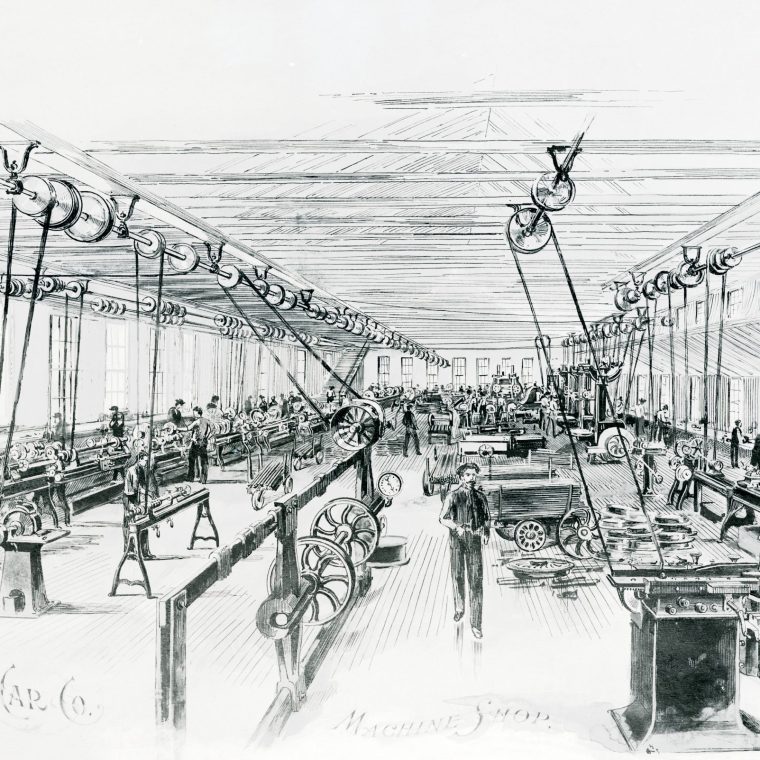

The machine shop pictures I posted yesterday were not a fluke. That pattern – modern machinery in an older and old-fashioned building – was common at the beginning of the 1900s. The old factory buildings were functioning just fine, so there was no rush to replace them, but the machines were being modernized with greater power and particularly greater speed, made possible by the introduction of high-speed steel for cutting edges. This all changed in the next few decades as moving assembly lines and automation changed traditional factory work and required buildings with larger floor layouts and higher roofs.
The illustration above, with it’s improbably well-dressed workers and it’s improbably clean floor, is from the catalog of the Sheffield Car Company of Michigan, which made handcars for use on railroad tracks. (To be honest, I first learned about handcars from watching Warner Brothers cartoons and my opinions on the topic are, perhaps, brightly colored as a result.) The Sheffield catalog is a wonder, with bicycle handcars, sail-powered handcars, and so on. Even in that stylized drawing, the old wood-truss roof of the factory is hinted at, and the shafts running the length of the building for belt-drive power are emphasized.
Here’s a photo from the same era (1900 to 1910):

That’s a metal-stamping press at the Glazier Stove Company of Michigan. It looks like we’re seeing a pile of stove panels on the left, although this photo looks staged. The press is quite grand, but look at its surroundings: wood roof trusses (we can see on the left that they’re not heavy timber but rather ganged 2xs or 3xs), and a brick bearing wall with a four-course jack-arch head. In other words, modern machinery in an old-fashioned building.
You must be logged in to post a comment.