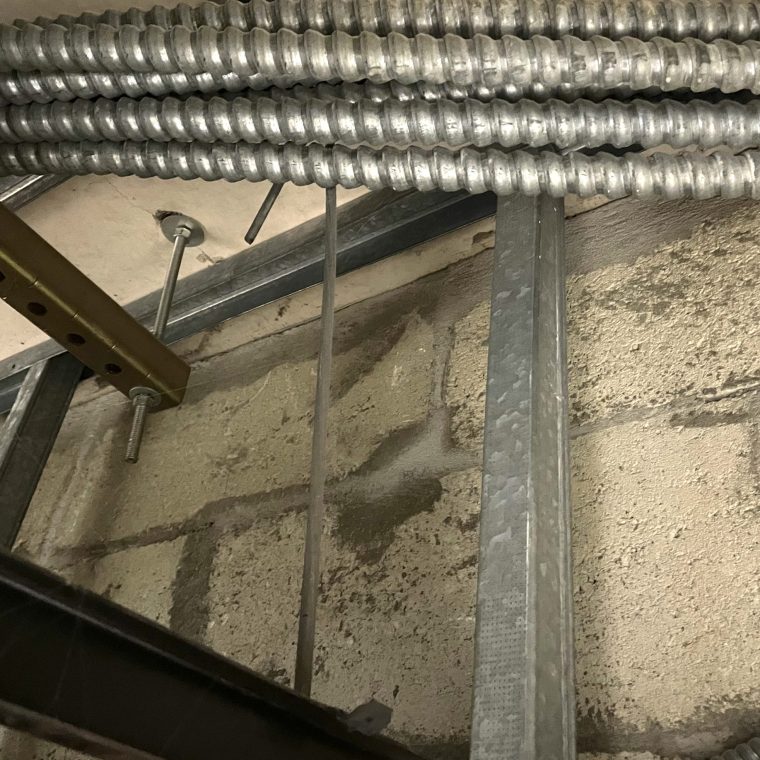

A minor oddity of structural investigation is that we get a lot of of information from secondary and minor damage. Which way is something moving? Look for cracks in plaster or rips in gypsum board. In most buildings the actual structure is hidden by architectural finishes, so we see it either not at all or through small probes. The picture above is an example of what you see through a probe, taken by me while standing on a ladder, with my head and right hand (hiding my phone) sticking up through a hole in the ceiling.
There’s an oddity to the picture that’s worth a few moments. This is a “block and plank” building, with floors consisting of precast concrete plank bearing on concrete block walls. This form was popular in New York in the 70s and 80s, but has been used less more recently, since we got seismic loading added to our local building code in 1996. It’s possible, but not easy, to introduce enough reinforcing at the plank-to-block joints to provide the necessary continuity for seismic design; the cost of doing so reduced the advantage this form once had. But that’s not what I wanted to talk about.
Between the electric conduit and the secondary framing for the ceiling and partitions, we see the joint between the plank and this block wall:

That’s a continuous horizontal crack. You can (I did) slip a piece of paper in there. The thing about continuous horizontal cracks is that they should not exist. Gravity is inexorable. You can get short and discontinuous horizontal cracks when there’s a local force strong enough to push against gravity: rust jacking at loose steel lintels, for example. You can get a continuous horizontal crack, to extend that example, if you have a hung shelf angle that’s rusting: the crack is in the veneer masonry, and so is not very deep, but it will look like something like this. But that’s not what’s going here: the cracks runs clear through the floor/wall joint and there’s no lintel here to rust.
That crack means simply that there is no force transfer from the floor above to this wall. There’s no great mystery: this wall is a partition and there’s another structural wall not far away. What I find nice is that physical reality is conforming to the designers’ intentions: the partition is not carrying load even though it’s capable of doing so. This is a reversal of a fact common to building investigations: non-structural elements like partitions don’t know they’re not supposed to carry load, so they often do; in this case, even though the “non-structure” is a sturdy masonry wall, it is not carrying load.
One last comment, for the more technically minded: how? One possibility is that the plank is continuous over the nearby support, which would create negative moments that could cause upward deflection under pattern loading. A slightly more likely scenario is that the small up and down movements under changing load have gradually cracked and spalled the 40-year-old mortar at that top joint.

You must be logged in to post a comment.