

To finish up Master Builders, let’s discuss clay masonry at the Woolworth Building. So much clay masonry. The facades, other than the bottom floors, are entirely terra cotta backed by brick; the floors, with a few exceptions, are entirely terra cotta tile-arches spanning between the steel beams of the frame. The picture above, intended to demonstrate the waterproofing of the set-back roof, shows the floor construction. The two floor beams – a channel against the inside face of the parapet and an I-beam directly below the word “tile” are shown in black and fade into the background compared to the complexity of the tile arch. As drawn, it’s an old-fashioned (for 1913) form of vault: side-construction, so that the voids in the hollow terra cotta blocks run parallel to the beams, and without flange blocks to provide fire protection to the bottom flanges of the beams. The bottom flanges are fireproofed in this system with plaster, which is a perfectly fine material from the standpoint of insulation and basically the same stuff we use today in fire-rated gypsum-board enclosures, but is more fragile and subject to cracking and spalling than terra cotta would be. I’m curious if that’s actually the type of tile arch used at Woolworth or if the illustrator copied it from an old catalog. Flange blocks were pretty much standard after 1900.
But let’s face it: if we’re talking about terra cotta at this building, everyone’s interested in the facade.

The first floor of the facades has granite veneer, then limestone veneer up to the top of the third floor, and then terra cotta veneer for everything else. The book says 7500 tons of terra cotta, which is believable and 17,000,000 common bricks, which is even more believable. The building has a large floor plan for the first thirty floors, very thick walls, and is very tall. To put it another way, a cubic foot of common brick laid up in common bond contains 20 and a quarter bricks; a wall (generically, not at Woolworth) 16 inches thick, twenty stories high (at ten feet per story), 100 feet long (half a block in the numbered grid), and 50 percent window contains (16/12) * (20*10) * 100 * 50% * 20.25 = 270,000 bricks…and that wall is small compared to Woolworth.
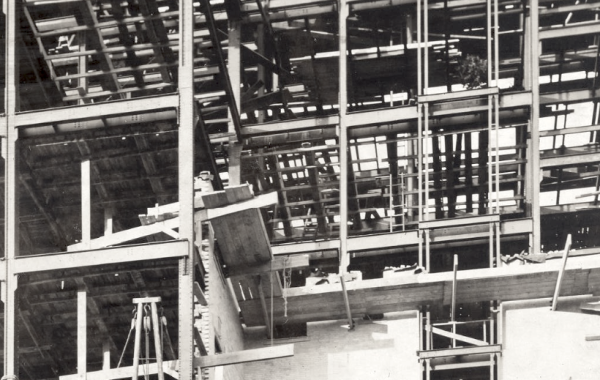
Getting all that brick and block into place is a far bigger effort than manufacturing and supplying it. The book has a page devoted to the scaffolding used by the masons and roofers.

Not only do those citrus give a sense of the assembly-line quality of doing so much work so quickly, they are both horrifying (no personal protective equipment, no fall protection) and beautiful (nice views of the Hudson River and the city below).
You must be logged in to post a comment.