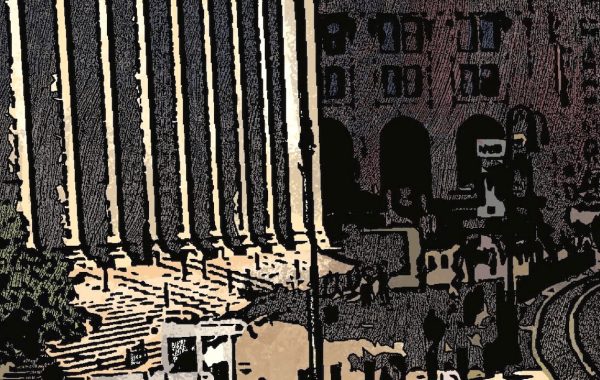
…intersections between architecture and structure: arched window heads. That’s the 1890 Bell Telephone of Pennsylvania Building in Pittsburgh. It was built as a “switching hall,” where operators sat at literal switchboards and connected calls by plugging a wire representing one line into a socket representing another. People need light, so unlike modern switch buildings which are featureless and unoccupied monoliths, this looks like a regular building, with a lot of windows to bring in daylight. The romanesque style and dark masonry are good reminders that this was built in high style before the 1893 Columbian Exposition in Chicago made classical revival the hot style of the day.
Since this is a reasonably typical romanesque building, what jumps out at me is all the arches. The window heads at the fourth floor, at the sixth floor, and what’s either a partial eighth floor at the turrets or more likely just a well-decorated parapet. (The loss of the main cornice is unfortunate.) The arches were there for style, not because there were no alternatives: look at the seventh floor window heads for massive stone blocks used as lintels, the second floor for short brick spandrel panels over small (but still big) stone lintels, and the ground floor storefronts for stone flat arches.
To look closely at one example, the fourth floor of the short facade (on Seventh Avenue) has five bays and we have three different arch conditions. The center bay is a fairly normal half-circle arch, the bays on either side (the second and fourth bays) have segmental arches with roughly twice the span and about half the rise, and the end bays are in turrets that have not-quite-3/4-circle floor plans. There’s not much to say about the center bay: it would be difficult to mess up that design so badly that it wouldn’t work.
The second and fourth bays low-rise arches are tougher, at first glance. The shallower an arch is – the smaller the rise relative to the span – the greater the horizontal thrust. These bays are not at the ends of the building, but they abut the turrets, which means that their thrust isn’t being taken into a continuous wall, but rather into the piers that separate the flat wall from the turrets. That would be okay if the end arches’ thrust was in the same plane, but it can’t be. Arches in a curved wall with a tight radius of curvature, like the arches in the turrets, are really problematic, as traditionally-developed thrust lines for the arches leave the plane of the masonry and are therefore not restrained by the adjacent masonry. So the arches in the turrets “don’t work” for that reason and the arches in the adjacent bays “don’t work” because there’s no properly offsetting thrust from the turret arches.
Why the scare quotes on “don’t work”? Because those arches have been there for over 130 years, so I think it’s safe to say that they do work. It’s possible to look at three-dimensional restraint of an arch on a curved wall, converting the out-of-plane torque into horizontal forces in and out of the plane of the wall. If those forces are low enough, the wall can restrain the out-of-plane kick from arching along a curved wall. And if you look closely, these arches are not very heavily loaded at all by masonry. The center and turret arches support only a short spandrel panel up to the window sills of the fifth floor; the low-rise arches support little colonnets that run up a floor as windows separators, but that’s still a small load. I don’t know which direction the floors span or if they’re wood-joist or (more likely) much heavier fireproof construction, but in any case, the tributary floor area bearing on the wall is small. When I’ve analyzed walls like this, the weight of masonry dominates over the floor dead and live load. In short, if the load on the arches is small enough, a lot of oddball load paths might work.