
I’ve mentioned telephone switch buildings a few times but never really discussed them. They are pretty much what the name implies: buildings that were built to be full, or mostly full, of the switch equipment that is used to route phone calls. The older ones still around were built in the days of electro-mechanical switches, which actually moved as they worked and were much, much larger than the electronic switches that replaced them. As the number of phones in use in Manhattan grew after World War II – as party lines were replaced with private lines, as businesses got more than one line in, as telexes and then faxes grew in popularity, more and more switches were needed. So more buildings were constructed in the 1950s, 60s, and 70s to house them.
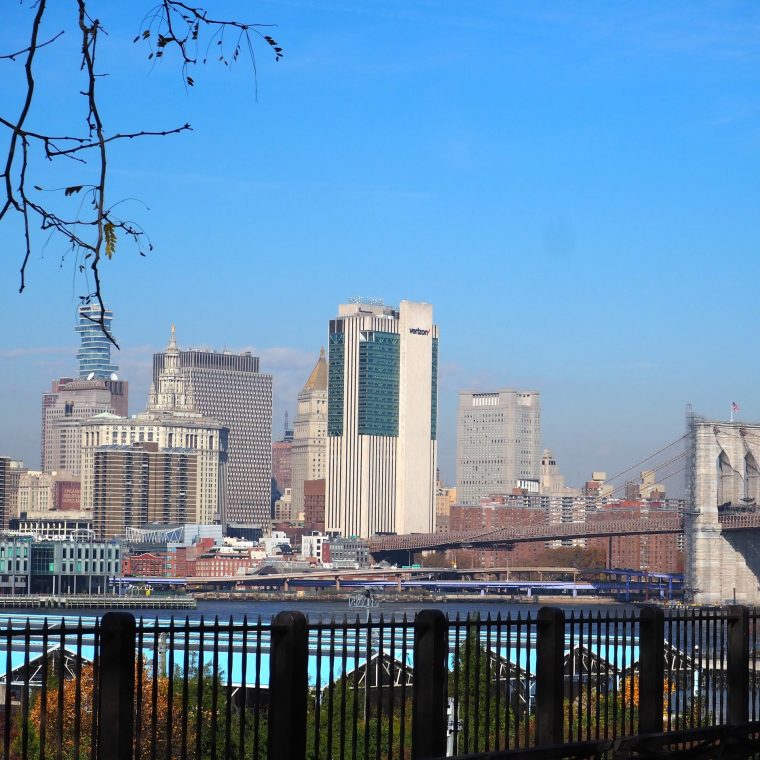
The picture above is one that Tim Michiels took this past winter, showing lower Manhattan north of Chambers street as seen from the Brooklyn Heights Promenade. The Manhattan tower of the Brooklyn Bridge is off to the right and the unfortunately most-prominent building is a switch building. The white and green tower in the middle with a Verizon sign, 375 Pearl Street, is a 1976 switch building. As built, the entire building looked like the bottom: white with very narrow vertical strip windows. It was full of automated equipment and not people, so the only windows were at the ends of long rows of racks of switches. The facade layout directly related to the interior equipment layout.
Because most of the building was not needed for modern equipment, the upper floors have in recent years been converted to office space and the close-to-blank facade replaced with glass. This did not improve the building’s appearance or change the fact that it blocks views to and from the bridge. I dispute the Daily Telegraph’s statement that it’s the 20th ugliest building in the world, as I don’t believe it’s even the ugliest building in New York. In its current half-glass state, it’s more pathetic than aggressively ugly. Those last two words bring us to the 1974 Long Lines Building at 33 Thomas Street. Tim’s portrait:

Yes, it has no windows. The big openings at the top and midway up are vents for the internal air system. Its entrances are also raised above grade and hidden behind a featureless plaza surrounded by a fence. It resembles, more than anything else, the Ministry of Information in the movie Brazil, and that is not a compliment. I like Brutalism when it’s done well, but a 550-foot tower without windows is not, in my opinion, done well. Its appearance, however, is as true to its original function as that of 375 Pearl.
You must be logged in to post a comment.