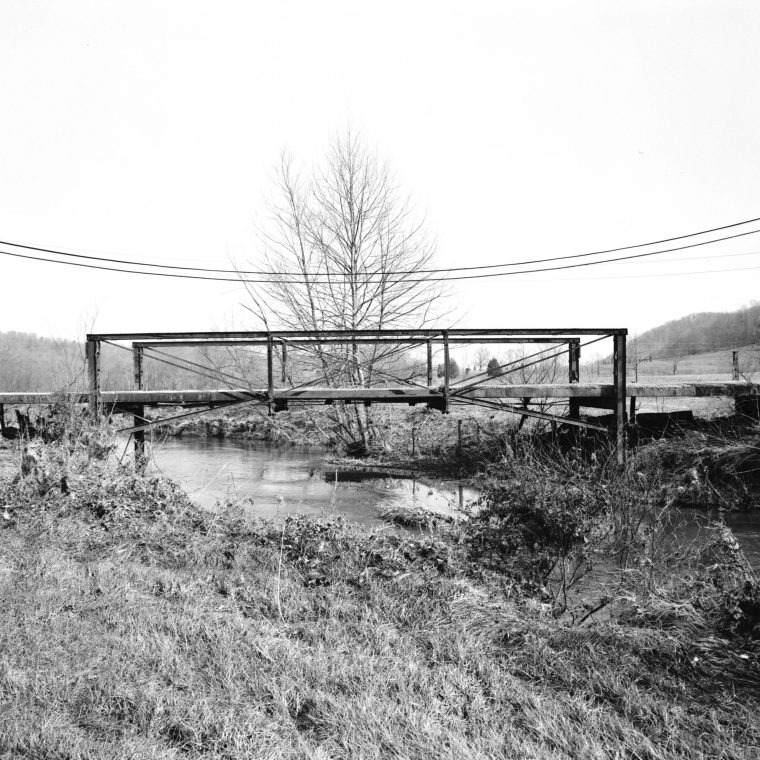

Today’s post is a second take on the bedstead bridge from Monday and a second take on the topic of scale that I discussed in one of the first posts on this blog. That picture is the 1898 Weaver Road Bridge over Paint Rock Creek in Roane County, Tennessee, and it’s a bedstead truss. It was demolished in 1985, two years after HAER recorded it.
Looking from the side, the name makes sense. It really does – at least to me – look like an iron-frame bed at a larger scale. Getting into the details, it’s supported by Pratt pony trusses, with the lower chords, as at the Sugar Creek Bridge, flush with the deck at the center panel and running diagonally down in the end panels to meet up with lower-leg extensions of the end posts, not quite halfway between the deck and the footings for the posts. The diagonals and center-panel bottom chord are bars, the end posts and top chord are built-up boxes, and the intermediate posts and end-panel bottom chords are built-up Hs.

But, and I need to stress this, it’s really tiny. The deck is one lane wide at 12 feet and the trusses are 42 feet long. The overhead wires were probably not there when it was built – certainly neither electric nor phone wiring was there, but there might have been telegraph wires – and the fact that the wires have a pole-to-pole span significantly longer than the bridge itself gives a sense of how small it is. Looking at the bridge from one end also gives a feeling for it.

Why am I harping on the size? Because bed frames are a terrible model for bridges. As I mentioned on Monday, a large or heavily-loaded bedstead truss will have very large moments in the end-post lower legs and accounting for that would run counter to everything we’re seeing in this lightweight design. An ordinary Pratt truss has no moment in its end posts because the posts have no connections other than at their ends at the top and bottom chords. Assuming that an ordinary Pratt-truss bridge bears on the connection between the end posts and the bottom chords, the end posts will rotate slightly inward when the bridge is loaded. Look at the side profile up at the top: with a bedstead, that rotation takes place around the lower-chord connection.
This form works great for beds and obviously can be made to work for small and light-loaded bridges. But the end-post problem will grow faster than other issues with increased size. There’s a reason that suspension bridges typically have end spans rather than anchoring the cables to the top of the towers: the towers would be insanely difficult to design for the full cantilever moment from the pull at the top. The issue here is similar.
If this form is so limited, why use it all? I suspect the answer is “no abutments.” You just need four small foundations for the posts, and maybe not even that. I can see someone founding a bedstead bridge by digging holes in the ground, and sticking the legs of the end posts into the holes wrapped in tar paper or some similar protections for the steel. These are great bridges to be pre-fabricated elsewhere and erected on site with minimal skilled labor. Pretty much anyone who could build a house could have built stone foundations designed to take nothing but vertical load.

Permalink