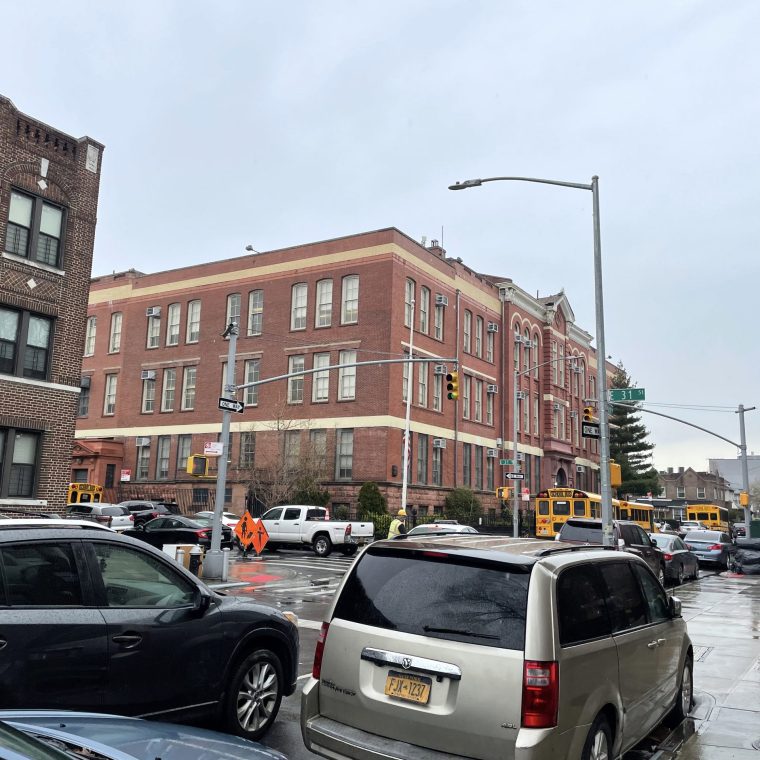

Interrupting this week’s intended discussion of bridge failures…I was in Flatbush yesterday and took the picture above. It’s obviously a school building (or obviously a school to anyone who knows what NYC public schools look like) but there’s something not quite right about the architecture.
Looking at this photo and a historic photo that’s floating around on the internet (and, annoyingly, marked as copyrighted even though it’s from 1905) I came to the conclusion that while it’s clear that the building has been expanded once, I think it was expanded twice. This was PS 89[efn_note] A lot of public school numbers are reused in different boroughs. When I was at PS20 in Flushing, we always wrote it as PS20Q to distinguish it from PS20M, PS20X, and PS20K.[/efn_note] when built in 1897, and that date is significant. Consolidation – the city of New York swallowing Brooklyn, Queens, and Staten Island (having already swallowed the Bronx in two gulps in previous years) – took place in 1898. So this school was built by the independent city of Brooklyn rather than the city of Greater New York. And that matters because in the late 1890s design of NYC schools was firmly in the hands of C.B.J. Snyder. Snyder revolutionized school design in the city, creating buildings that were so well designed that quite a few are still in use either as schools or converted to some other purpose.
Snyder’s buildings have a very distinctive look, with deep courtyards at the front, back, or both to serve as yards; gothic or vaguely Georgian styling; and very large windows. This isn’t a Snyder school and that’s why it looks wrong. Very few pre-Snyder schools survive in the city, and the ones I know of are all in Brooklyn, which had its own sizable public school system before 1898.
Yesterday’s photo above shows the building as seven bays wide along along Newark Avenue, the street at the front facade. The historic photo from 1905 that I linked to above shows it as five bays wide, missing the two ends. Meanwhile, I’m pretty sure that the original building was the just the three center bays, the portion with the round windows at the third floor.

See the way that the white (wood) cornice turns the corner and dies into the red brick? That’s wrong. And the problem isn’t that the cornice on the side wing has been removed, because that cornice was lower down, where the yellow brick infill is. If that cornice corner was intentional, then the original designer was incompetent, and the fact that the building is still in use at the age of 125 suggests that it’s pretty well designed. So my scenario is that the city of Brooklyn built a relatively small school in 1897 – this area was semi-suburban at the time – and it was quickly expanded as more housing was built nearby. The area really boomed when the Nostrand Avenue subway opened in 1920, and it’s hard now to picture it as empty lots being gradually filled in.
As for fame, this was Barbra Streisand’s elementary school for a while, which is a fact hard to miss on the internet once you start taking a look at the building’s history.


You must be logged in to post a comment.