
There are two readings of the topic of this post: that bad taste is timeless, or that the need to provide news in a popular format is timeless. Take your pick.
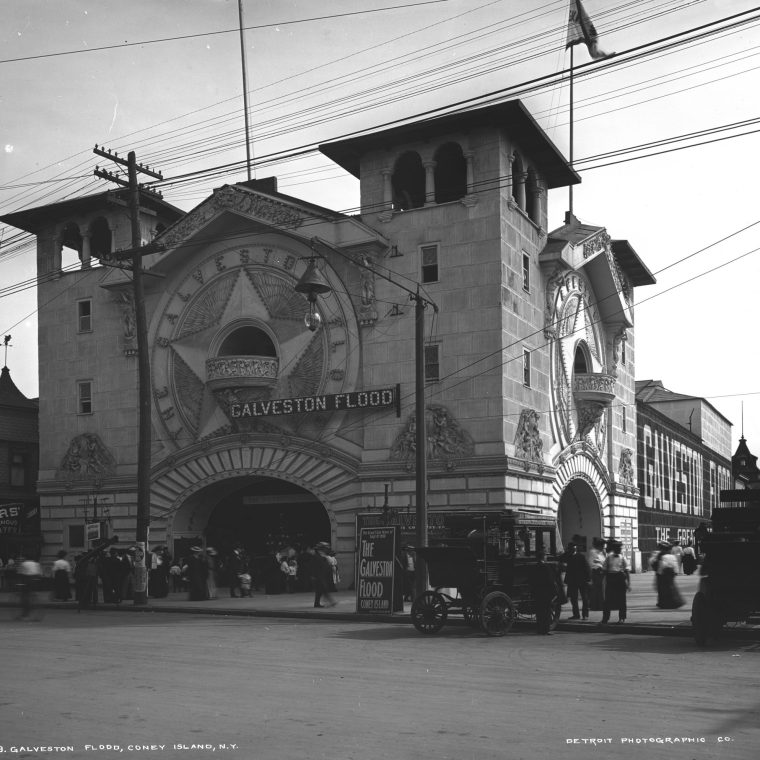
The picture above shows an exhibit building in Coney Island that opened in 1902 and closed a few years later. It presented a dynamic model of the city of Galveston before, during, and after the 1900 hurricane that destroyed most of the city and killed at least 6000 people. It was far from the only such spectacle presented as summer entertainment. Here’s the copycat Johnstown Flood exhibit close by:

There were similar exhibits/models/dioramas on other disasters, including the eruption of Mount Pelée on Martinique and the San Franscisco earthquake and fire of 1906. This kind of thrill was everywhere in Coney Island: Dreamland had a fake fire in a tenement building every day.
There are multiple levels to this topic. The exhibit buildings themselves were poorly constructed wood-frame structures with plaster making up the bulk of the “stone,” which is why there were so many real fires there. There were no mass-casualty events at Coney Island, but given the crowding and the rickety nature of the attractions and buildings, that may have been luck. The exhibits ranged from purely educational, to the mix of educational and lurid represented by the two flood models, to the purely lurid. People went, by the thousands, so we have to look at the question of why the “educational” veneer was used. It didn’t start around 1900, either: Barnum’s Museum was doing the same thing fifty years earlier.
In 1900, “news” meant newspapers. There were magazines but they were too expensive for most people and, speaking as someone who has read a fair amount of them, their quality was variable and tended towards not good. Radio was twenty years in the future, newsreels in movie theaters were ten years away. Newspapers had been publishing half-tone photos since the 1880s, but they were expensive and so rarely used at first. The real expansion of illustrated newspapers was, in 1900, still in the future. If you think about it, people really didn’t know how places they had never been looked, and didn’t know what historic events looked like unless they were present. These exhibits were an attempt to address that lack while, of course, making money for the proprietors. The huge catalog of the Detroit Publishing Company served a similar purpose: people who might never visit New York and might never see a skyscraper, or a long-span bridge, or one of the navy’s new battleships, could see them in the photos.
It’s unfortunate that horrible spectacles dominated this legitimate discussion of world events, but it’s not like that is not true today. We’ve just stopped constructing huge temporary buildings to house our displays of catastrophe.
You must be logged in to post a comment.