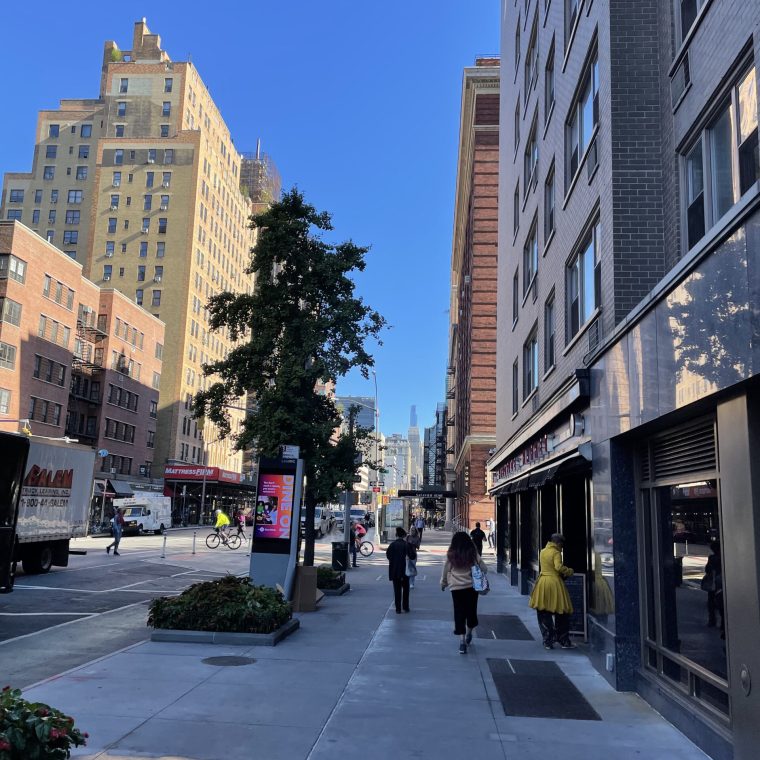

The picture above shows a pleasant fall day on Seventh Avenue in Chelsea. I took this picture because I was struck by something off in the distance: two tall buildings overlapped. Here’s the relevant portion of the photo expanded and marked up:

The green lines mark the 1930 Nelson Tower at 450 Seventh Avenue. It’s about as much of a background building as something 560 feet tall can be. The pink lines mark the top of the 2019 Central Park Tower behind it, at 1550 feet tall. So it’s time for a little rough geometrical figuring, based on the concept that if you know two sides and one angle of a triangle you can figure out the other side and the other angles. So here’s a list of what I know and what simplifying assumptions I’m making:
- I was on Seventh Avenue halfway between 14th and 15th Streets looking north. Nelson Tower is at the northwest corner of 34th Street and Seventh; Central Park Tower is slightly west of the northwest corner of 57th Street and Seventh. For the purpose of this blog post, I’m going to act as if the two buildings and I were in a straight line parallel to the avenue.
- Ordinary street blocks along the avenue are 200 feet long and ordinary cross streets are 50 feet wide. 23rd, 34th, 42nd, and 57th Streets are 100 feet wide. So the horizontal distance from me to the Nelson Tower is 19.5 times 200, plus 18 times 50, plus 2 times 100, or 5000 feet, which is just short of a mile. Since all New Yorkers figure that it’s 20 blocks to the mile, that sounds right intuitively. The horizontal distance from me to Central Park Tower is 42.5 times 200, plus 39 times 50, plus 4 times 100, or 10,850 feet.
- The bottom of the triangles[efn_note] In trigonometry terms, the adjacent side. [/efn_note] I’m going to imagine is a line at my eye level, roughly 68 inches above the ground, but I’m going to simplify that 68 inches to zero. For the purpose of the blog post, I’m also ignoring the elevation change (midtown is slightly higher than Chelsea).
- Each building represents the far side [efn_note] In trig terms, the opposite side. [/efn_note] of one of the two triangles.
- The one angle I know[efn_note] …I certainly hope… [/efn_note] is that the buildings are perpendicular to the ground.
Where does that get us? For each of the two triangles, I’m looking for the angle between the horizontal bottom line and the diagonal top line (the hypotenuse) from my eyes to the top of the building. For Nelson tower, arctan(560/5000)=6.39 degrees. (I’m using too many figures, but I can always drop some precision later.) For Central Park, arctan (1550/10850)=8.13 degrees. So I’ve proven that I should see the top of Central Park Tower over the top of Nelson Tower, which is an amazingly useless thing to prove given the photo that started this all. If the tops of the buildings perfectly aligned without changing Nelson Tower, then Central Park Tower would be (10850)tan(6.39°)=1215 feet tall. If the tops of the buildings perfectly aligned without changing Central Park Tower, then Nelson Tower would be (5000)tan(8.13°)=714 feet tall. So in practical terms, the triangles are very close: I was almost at the point where the tops would visually line up.
If I took similar photos walking forward, Nelson Tower would (visually) grow faster than Central Park Tower, so the point where they would align is closer to the two of them than I was. That point is easily found: 560/x = 1550/(x+5850), where x is the distance I’d have to be from Nelson Tower. Solving for x, I get 3309 feet, or more realistically 3300 feet, or 13 blocks. If I walked up to 21st Street, the tops should align. I’ll have to try that some time.
I’ll refund the blog fee for anyone finding errors in my math.
You must be logged in to post a comment.