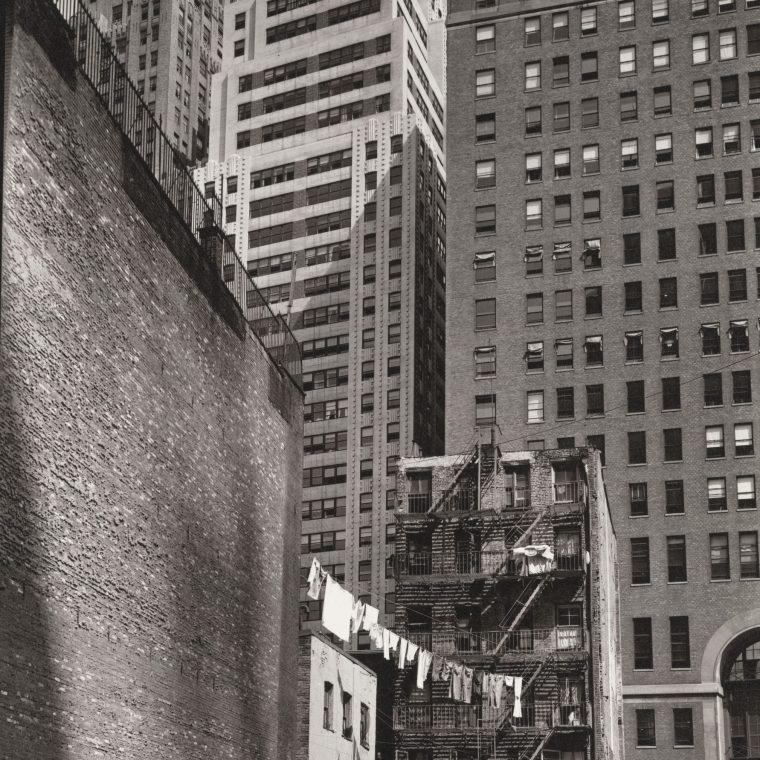

The photo above, a 1936 shot from Berenice Abbott’s “Changing New York” project, is titled “Construction old and new, From Washington Street #37.” It’s hard to come up with a more clichéd view than someone’s laundry hanging on a line in front of some skyscrapers. The big building on the right with the large arched entrance is the 1921 Cunard Building at 25 Broadway; the horizontally-striped building to its left is the 1931 tower at 29 Broadway. We’re actually looking at the back of those buildings from the west, with Cunard facing Greenwich Street and 29 Broadway facing Trinity Place. If that sounds odd, looking at a map might help:

That’s a plate from the 1955 Bromley fire insurance map, and it’s very close to our current street layout. The biggest difference is that the extension to the Battery Garage had not yet been built over the tunnel entrance. The Brooklyn-Battery Tunnel, arguably a mistake, as it encouraged drivers to treat lower Manhattan as a thoroughfare from midtown and the Upper West Side to Brooklyn, truncated Washington and Morris Streets and wiped out several blocks of houses and small commercial buildings. The Cunard Building is visible by name, just south of Morris Street, and 29 Broadway is the building opposite it on Morris. That weird little space where Trinity Place and Greenwich Street meet was not planned as a plaza, but rather was the result of changes to street layouts as landfill was added to move the Hudson shoreline two blocks west of Greenwich to West Street. So the back of 29 Broadway is at the very foot of Trinity Place, and the back of Cunard is south of the plaza facing Greenwich Street. Abbott’s perch, the building at 37 Washington Street, was on the east side of the street, the side demolished for the tunnel. So here’s a pre-tunnel map, from 1894:

That looks more like a normal city layout, even with oddities like little Edgar Street. The big building visible at 29 Broadway is the first skyscraper at that address, from the 1890s, which was demolished for the 1930s building. The site of the Cunard Building is still a bunch of small buildings. The building coded in green on the right side of Washington, one building south of Morris, is number 37. So the building with the clothesline is 38 Greenwich. Note that in 1894, big business and high-end real estate had not yet spread west from Broadway and Trinity Place: the future site of the Bowling Green Building at 11 Broadway was, in part, a lumber yard. By 1955, the big buildings had made it to Greenwich with a few pioneers on Washington and West.
The two books of landfill originally had residences and businesses serving the nearby docks. As the use of the downtown docks declined, so did the life of that mini-neighborhood. It would probably have hung on, but it must have looked like easily-vacated land to the Tunnel Authority. The north half of that neighborhood lasted a few more years and then was wiped out for the World Trade Center site. Abbott’s characterization was a cliché but it was also right on target.


You must be logged in to post a comment.