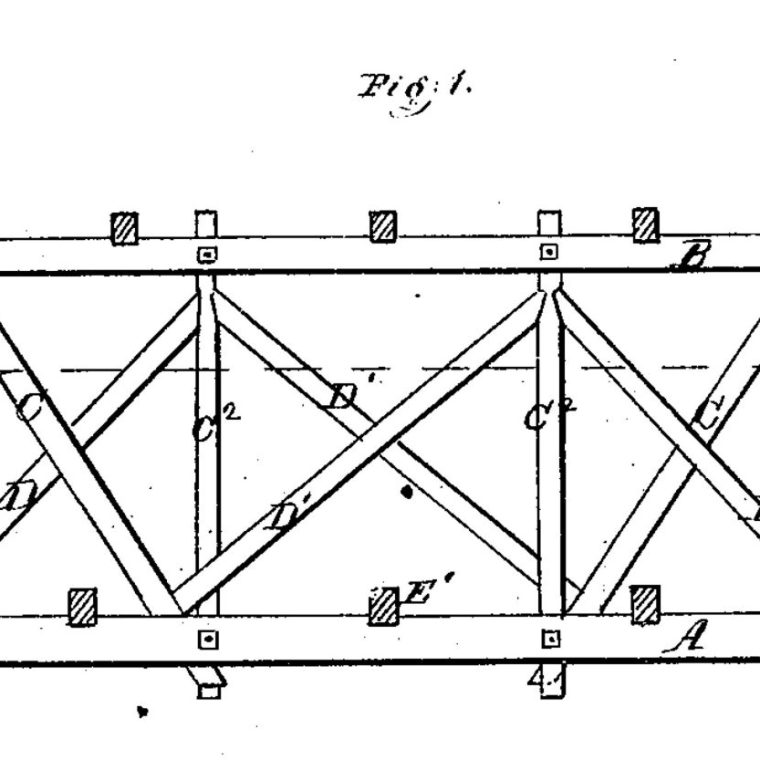

Yet another obscure truss form that I had not heard of, coming at me from the HABS/HAER index: the Smith truss. The picture above is from Robert Smith’s 1867 patent and I’ll make this short: that’s a double Warren Truss. The connections are a bit odd, possibly reflecting Snith’s carpentry background, but the layout of the web – almost entirely diagonals, typically intersecting mid-height and with aligned top and bottom panel points – is a double Warren. There’s no single HAER survey that has both photos and drawings of one of these creatures, so here’s a photo from the Cataract Falls Bridge over Mill Creek near Cataract, Indiana:

There’s some beautiful joinery in how the two planes of diagonals meet the top and bottom chords and in the top roof and wind bracing, but those are still double Warren trusses. Also, note the redundant redundancy of the names: a cataract is a waterfall, and mills were located on creeks that had either waterfalls or rapids that could be readily dammed to create an artificial waterfall to create head for a waterwheel. So “Cataract Falls” at “Mill Creek” is a bit over-determined.
Here’s a drawing showing the main trusses (top) and wind bracing in the floor (bottom) at the Cumberland Covered Bridge over the Mississinewa River in Matthews, Indiana:

The presence of the iron-bar verticals makes the overwhelming resemblance to a double Warren truss ever more, uh, overwhelming.
Besides picking on Mr. Smith, who’s been dead for more than 120 years, I do have a point. Categorization – of anything, but to keep this from being a 100,000-word blog post, I’ll stick to structure – is not the same thing as the objects being categorized. There are a finite number of ways to get forces spanning from one bridge abutment to another, and that number is smaller than the number of people who were experimenting with bridges in the US in the mid-1800s. To use a different example, there are a finite number of ways to transmit gravity and lateral loads in a tall building to the ground, but there many be minor variations in every tall building built. My categorization of early skyscraper frames in The Structure of Skyscrapers is simply that: my view of things. It came along 110 years after the fact for the newest buildings discussed, and it is based on my perspective as an engineer. It means nothing to the buildings themselves and is only useful if you accept some of my arguments. I suspect Smith really did believe he had invented a new way to build a bridge. It’s not his fault that, using a different set of analysis criteria than he used and my own categorization method, I come to the conclusion that he invented nothing.
TL;DR: Anyone who tells you that STEM is based solely on the physical world and is therefore free from opinion is wrong.
You must be logged in to post a comment.