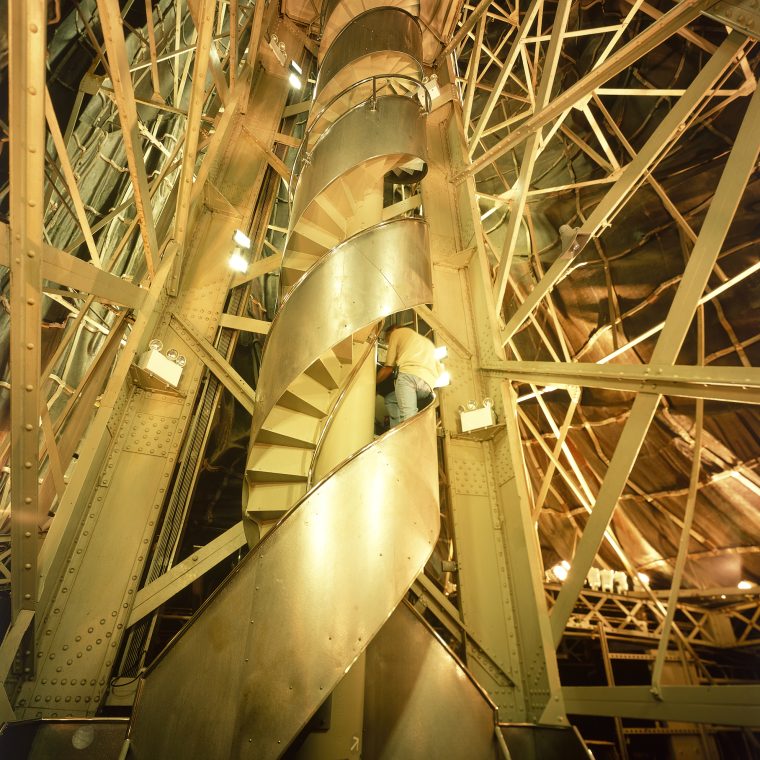

I’ve discussed this topic before, but since three days ago was the first time I saw this photo, I know that I didn’t say exactly what I’m going to say here. That’s a photo, from the 1984 HAER survey work, of the interior of the Statue of Liberty. There’s a nice distinction to be made: exterior views of the statue show off Frederic Bartholdi’s design work; interior views show Gustav Eiffel’s. That’s his wrought-iron frame – along with the helical stair that I first climbed in, I believe, fourth grade – occupying the foreground, with the copper skin in the back.
The main structure of the statue consist of a central pylon: four main vertical members tied together with X-braced lacing. The verticals are actually sloped in a bit at the top, and we’re looking at two of them on either side of the stair with a third, nominally behind us, visible at the upper right. The verticals are huge built-up angles, and the lacing consists of pairs of angles riveted together as Ts. The stair and the distance from the photographer to the stair gives a sense of the amount of space inside that skeletal pylon.
The pylon supports a bunch of outriggers that are similar to the lacing. You can see some of it clearly just below the light on the upper right. The outriggers serve the purpose of filling the distance between the irregularly-shaped copper skin and the rigid geometry of the pylon.
The outriggers support a rough grid of thin iron straps that are loosely fastened to the inside face of the copper. You can see the straps most clearly on the lower right. “Loosely fastened” because the skin is subject to thermal movement and deflection from wind load. The straps, like the skin, are too flexible to prevent that movement, but they’re strong enough to transmit the forces back to the outriggers. The original connections between the straps and the skin had a layer of asbestos to ease the relative sliding movement; more modern and less dangerous materials were substituted in the 1980s restoration work.
These specific levels of structural hierarchy are unique to the statue, but the general idea is actually fairly widespread. You’ve got base structure as the top level of hierarchy, with geometry that follows structural logic rather than the architecture. You’ve got the structure of the architectural element, that follows the architectural geometry, at the bottom of the hierarchy. And you’ve got something in-between that fills the gap. A programmer might refer to that middle layer as virtualization.
Obviously all three layers are needed for the structure to work as intended. You can combine the central frame and the virtualization – I believe this was done at Guggenheim Bilbao – but that makes the main structure much more geometrically complex and is therefore more difficult. It was arguably impossible to make that combination before the advent of three-dimensional CAD programs.
I’ve designed that middle layer in many alterations, as a way to get new interior geometry (architectural or mechanical systems) to work with the existing structural grid. My designs just don’t inspire the awe that Eiffel’s rightly does.