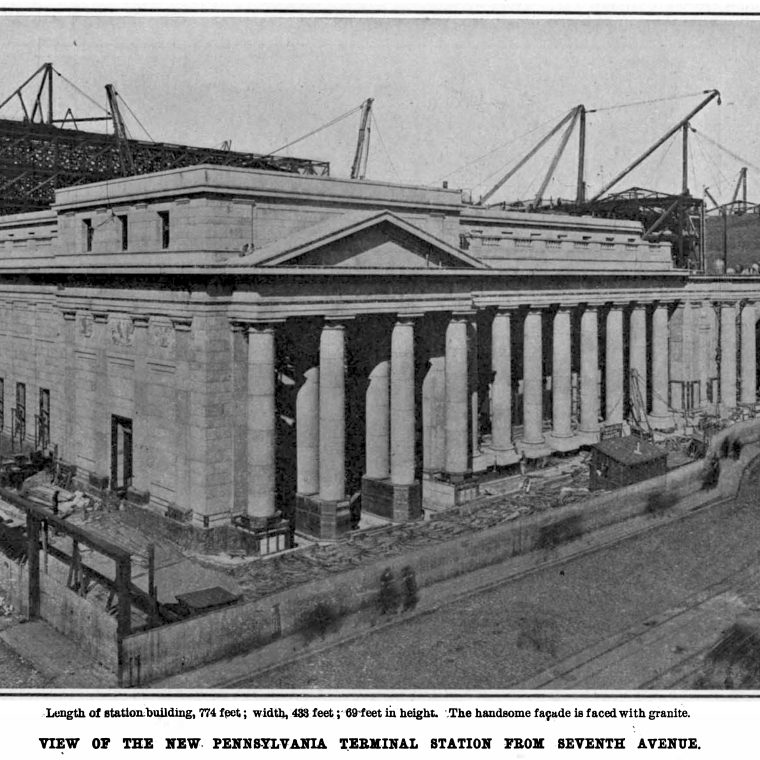

The construction of Penn Station itself was less daring than the construction of Grand Central Terminal, for the simple reason that Penn Station was not in use until the work was effectively complete. The complex system of construction in sections used at Grand Central (and described yesterday) was a logistical work-around to keep the existing train operations running while building the new station. On the other hand, Penn Station required tunneling under both the Hudson and East Rivers, so the overall project was more complicated. Since the Scientific American “New York” issue separated tunneling from the terminals, the discussion of Penn Station is shorter than that of Grand Central.
The picture above is a fairly ordinary view of the front (east) facade during construction. The exterior of the building, as well as the interior spaces other than the train shed, are McKim Mead and White’s answer to the question “what if the ancient Romans built a railroad station?” The magazine added a much more informative east-west section, parallel to the tracks:

Seventh Avenue, the east end of the station, is on the left; Eighth Avenue is on the right. As at Grand Central, the tracks are below street grade, but here they simply run level, two floors down, across the length of the station (and the width of Manhattan). The high-roof area in the center is the main passenger concourse, and everything public to the left is basically shopping and a grand entrance. In other words, the front door was on Seventh Avenue, but the actual railroad-use portions of the station didn’t begin until mid-block. To the right of the concourse is the train shed, the most photogenic part of the station and the actual entrance to the trains. That floor is a level below grade, closer to the trains. To the east (left) was the Long Island Railroad concourse and a lot of baggage-handling areas with little piles of suitcases carefully drawn. That area has been converted to other uses in recent renovations, now that long-distance train baggage no longer needs much space.
The view of early construction, when the site was basically a big excavation, is less inspiring:


You must be logged in to post a comment.