
I was in Albany last week and, as always, I took the train up and back. However, the train station is in the city of Rensselaer, on the east side of the Hudson River, and Albany is on the west side, so, as always, when I left the station I started walking. There’s one reasonable pedestrian route, over the Dunn Memorial Bridge, which connects the two cities and has a pedestrian sidewalk protected by barricades. What I didn’t know, until I had already walked a considerable distance (from the station to the entry ramp of the bridge on the Rensselaer side, up the ramp and across to the Albany side), was that the ramp from the bridge down to Albany’s Broadway is closed for repair. Even if I were inclined to walk on a closed bridge, which I’m not, a portion of the pedestrian deck has been removed, so the bridge is physically disconnected from the ramp.
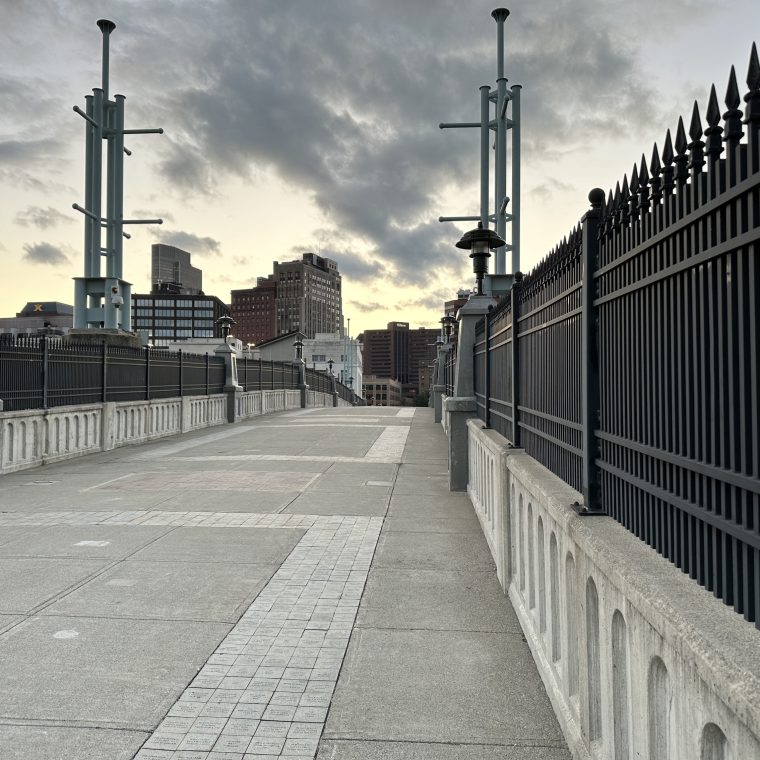
The planners for the repair work have provided a detour: pedestrians and bicyclists who cross the bridge continue on a lane made up of the shoulder of the highway ramp down to I-787, thankfully protected by temporary concrete barricades, until you reach grade and can turn off into the riverfront park, named after longtime Albany mayor Erastus Corning. To get from the park to downtown, you then turn west and cross the Hudson River Way, a pedestrian bridge over 787 and the freight rail tracks. That’s my picture looking west at sunset above.
So my route was a little longer than usual but safe and reasonably scenic. One thing struck me, though. The Hudson is not particularly wide at Albany, and the highway and railroad tracks are much wider than an ordinary street. The Dunn Bridge is a total of 984 feet long, but a non-negligible amount of that is the highway approach spans on either end. The Hudson River Way is 650 feet long, but almost all of that is actual pedestrian bridge over the highway. In other words, the pedestrian overpass is two-thirds the length of the river bridge, and the business portion of the bridges is about the same.