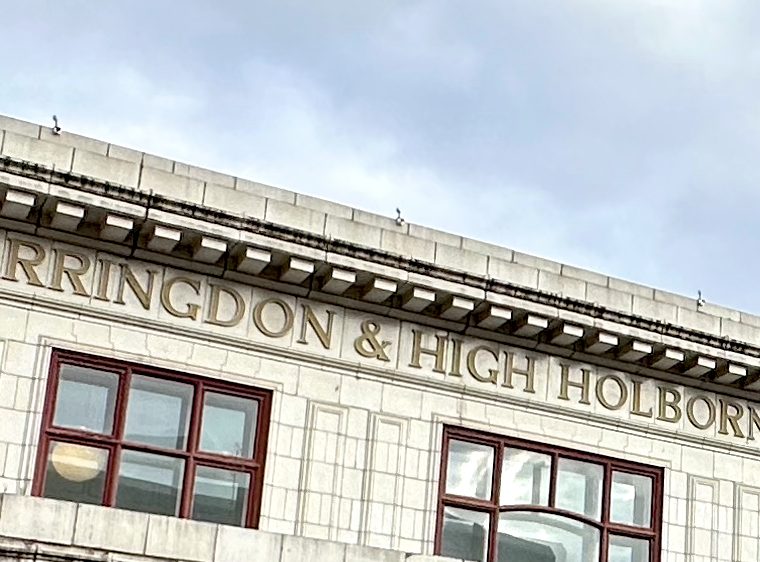

Speaking only for myself, it’s easy to mentally categorize subways (i.e., electric mass transit, mostly underground) as something different than railroads. Different lengths of routes, different spacing of stations, different rolling stock, and so on. The differences are often less than they seem, and the further back you go in time, the smaller those differences get.

That’s the entrance to the Farringdon Station of the London Underground. That building dates from 1922, but it’s the third station at this locations, with the first constructed for the original portion of the Metropolitan Railway in a mind-boggling 1863. The name gets at the blurred line between a railroad and a subway: the Metropolitan was physically a railroad with coal-burning engines and stations much like an ordinary railroad, and it carried freight, but it was below grade in cuts and tunnels and had closely-spaced stations. A traditional railroad station has two pieces of building: the track and platform area, which might be outdoors or might be enclosed in a shed of some kind, and an associated building, the headhouse, with ticket sales, railroad offices, and support spaces. In short, an area primarily for trains and an area for people. My photo shows the headhouse of the 1922 station, and the platform area is below. That configuration was used for ordinary railroad stations in the 1800s, particularly in the UK, when the railroad was in a cut. As subways developed into something distinct from railroads – a change that accelerated after electrification – subway stations didn’t necessarily need headhouses, and many modern stations have been built without them.
There are examples in New York: the Dyre Avenue branch of the 5 train and the Rockaway Branch of the A train were both built as commuter railroads and taken over by the subway; there was a scheme, eventually abandoned, to run Long Island Railroad trains over the IRT by building connecting tracks at the Atlantic Avenue station; and all of the subway lines in southern Brooklyn follow the routes of long-ago, long-gone railroads. In several areas where the subway runs in an open cut (the B and Q trains on the Brighton lone, for example) the stations are entered through little headhouses roughly similar to the one in the photo above.
You must be logged in to post a comment.