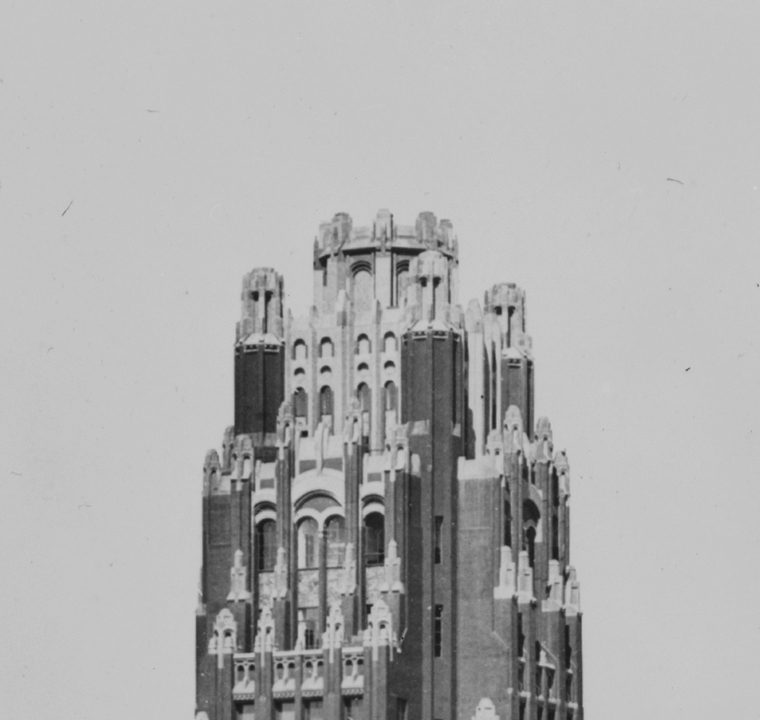

As I’ve said many times, in many venues, there really isn’t an objective description of “skyscraper.” That said, nearly everyone’s subjective definition contains a version of the idea that a skyscraper is tall for its context. Here’s an Irving Underhill photo centered on the American Radiator Building (later, the American Standard Building) by Raymond Hood in 1924 or so, when it was brand new.

There are a few tall buildings in the photo. On the far left is 10 West 40th Street at 21 stories; the building with the very prominent square window surrounds right next to American radiator is the Engineers’ Club 15 32 West 40th; the building behind the club is the Engineering Societies Building at 25 West 39th Street; and there’s that very white building on the far side of Sixth Avenue, off in the distance. I’ll argue that American radiator, by virtue of its design looks taller, looks more like a skyscraper. Compare it to 10 West, which is only two stories shorter. 10 West is a layer cake, with a series of floors, with mostly horizontally-oriented ornament, that have no great relation to one another visually, although they are in the same style. Same with the Engineering Societies. American Radiator, designed by Hood when he was, in his words, influenced by verticals, presents a much more unified appearance. The facade is near-black brick and the original window-shades, as seen here, were dark; that way the window openings during the day blended into the facade, making the building look almost solid. At 23 stories, it is not really very tall, but it seems tall.
To put it another way, there’s a reason that American Radiator has made it into the architectural history books and 10 West 40th has not.

You must be logged in to post a comment.