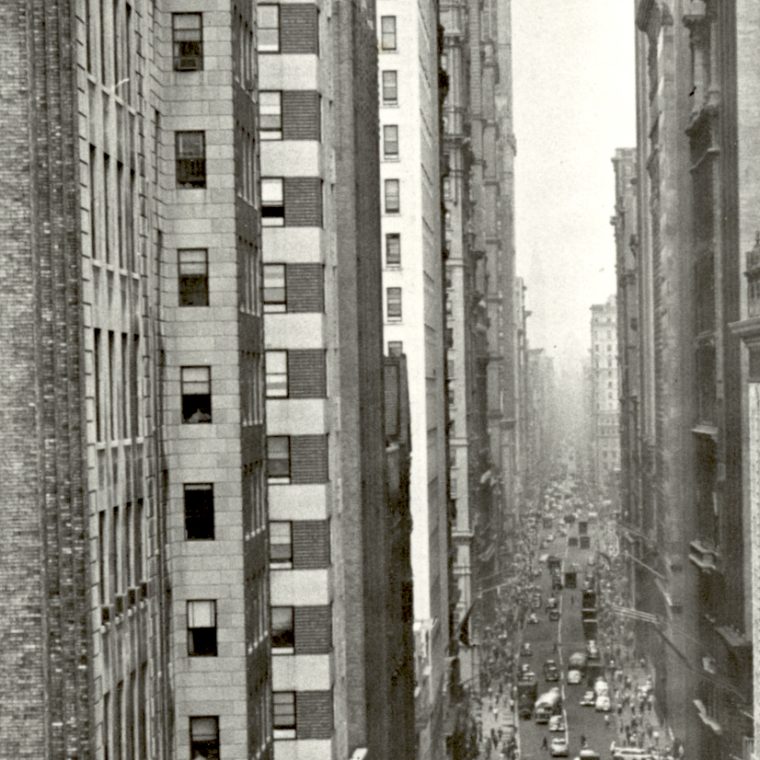

A few months ago I wrote about the appearance of streets lined with old, pre-zoning skyscrapers. I mentioned my two favorite examples: Thames Street between Broadway and Trinity Place, and Pine Street between Broadway and Nassau Street. I skipped the obvious example, Broadway, as seen here in a (probably 1950s) photo by Angelo Rizzuto:

In case you’re wondering how he took a photo directly up the street in mid-air, 1 Broadway is set at a slight angle to the rest of the buildings, because of the curve as the street reaches its southern end at Bowling Green. We’re looking from a rear window of that building, with a piece of its mansard roof visible as the diagonal at the lower left. The building on the far left with individual bricks visible is 11 Broadway, then the Cunard Building at 25 Broadway with its little obelisks; then the horizontal stripes of 29 Broadway, and so on. The big, white, boring Adams Express building is blocking our view of the Singer Building, but Woolworth is visible about half a mile away.
At that time, Broadway still qualified as one of the canyons, even though its greater width made it less claustrophobic than Thames Street. But redevelopment of a number of sites on Broadway under the newer 1960 zoning law led to the construction of some plazas, loosening the sense of it. In this photo, you’re trapped between continuous street walls of tall buildings, and that feeling is no longer so storng.

You must be logged in to post a comment.