
[This post was edited after posting, with the edits marked in square barckets. My thanks tio the reader who pointed out my error.]
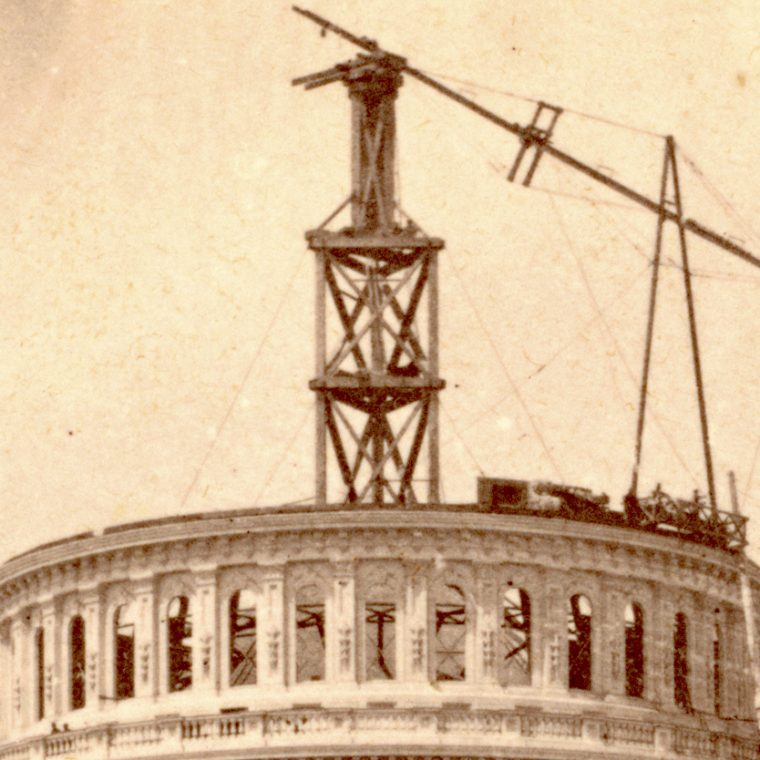
The central dome of the US Capitol on May 9, 1861:

There was a certain symbolism to its incomplete state given that the Civil War had begun the previous month, but that was a coincidence. The replacement of the original wooden dome had been planned for some time. The old dome was too small, architecturally, having been sized for the building before the wings were added, and was a fire hazard in an era where “artificial light” meant “flame.”
The new dome took ten years to build from start to finish, in part because of the war but largely because of logistical and design issues. In any case, it’s interesting to me that common descriptions consistently describe the structure incorrectly. The description at the Architect of the Capitol’s website, for example, call is “cast iron” twice and “iron” twice. Similarly, the Wikipedia page calls it “cast iron” four times, despite having an original drawing that makes it clear why that’s only partially correct:

The dome consists of a cast-iron skin largely supported by a series of wrought-iron trusses. [Edit, 5 hours after posting: the trusses are a combination of cast and wrought iron, with the wrought iron used where tension was expected.] The cast skin contributes to the structural action but is not the main load-carrying element. So why are the trusses ignored? First, visible architectural elements are easier to understand than hidden structure. Second, as I’ve learned the hard way, non-engineers really don’t understand trusses and are sometimes freaked out by them. Third, there’s a common narrative in architectural history that cast-iron construction in the US was a stepping stone to steel frames, which really isn’t true (cast-iron facades are a form of bearing wall, not rigid frame, and I know of no building where the cast iron supports the structure without the help of masonry or wrought iron) and is a twentieth-century retcon of the technological development. In any case, feel free to put on a superior expression and say “actually, it’s a cast-iron skin over [Edit: combination cast- and] wrought-iron trusses” if you hear someone call it a cast-iron dome.
___
As for my title, the cast-iron foundry was in the Bronx. I don’t remember offhand where the wrought iron was rolled and fabricated.
You must be logged in to post a comment.