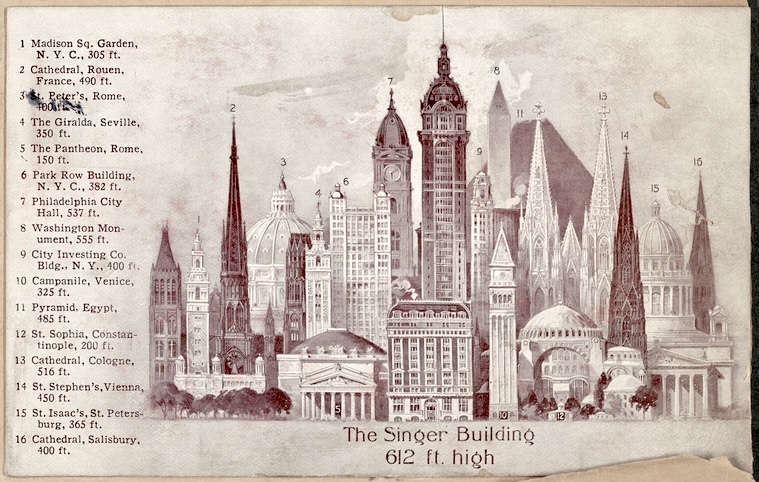

This type of imaginary collection was quite popular at the beginning of the twentieth century. Sometimes it was just buildings, like here, sometimes steamships were stood on end to show how big they were. (Note that the biggest steamship in 1908, when the Singer Building was new, was RMS Mauritania, which was 790 feet long and so would be the tallest human-built object in the drawing if stood on end.)

I’m not fact-checking the heights of all of those structures, but I have no reason that they’re not accurate to within, say, 5 percent. It’s worth noting that the Great Pyramid is 4600 years old and so about 2600 years older than the second oldest, the Pantheon.
The three newest are New York steel-frame skyscrapers: the Park Row Building of 1899 and the Singer and City Investing Buildings of 1908. Those three are not only newer than all the rest, they are fundamentally different: all the others are supported by bearing masonry. The five tallest out of seventeen structures are four bearing-masonry structures (one of them 4600 years old) and Singer, so we’re not yet at the point of modern-structure domination of height.
The point of these comparison seems to be a mild form of fetishism of modernity. “Look at how our new building / our new ship is bigger than anything from the past.” But emphasizing the truly modern aspect of the new skyscrapers, which is their steel frames, would require a technical discussion that doesn’t readily fit on a postcard.


You must be logged in to post a comment.