
It’s hard to over-emphasize how rail-centric New York City was before, say, 1920. In addition to the subway, there were the commuter railroads, which had many more stations within the city then than they do now, and a vast street-car network. The streetcars are entirely gone, mostly replaced by busses, and the subway system has grown, but the growth of new neighborhoods that are mostly accessible by cars is a 1930s and later (and particularly a post-World-War-II) phenomenon.
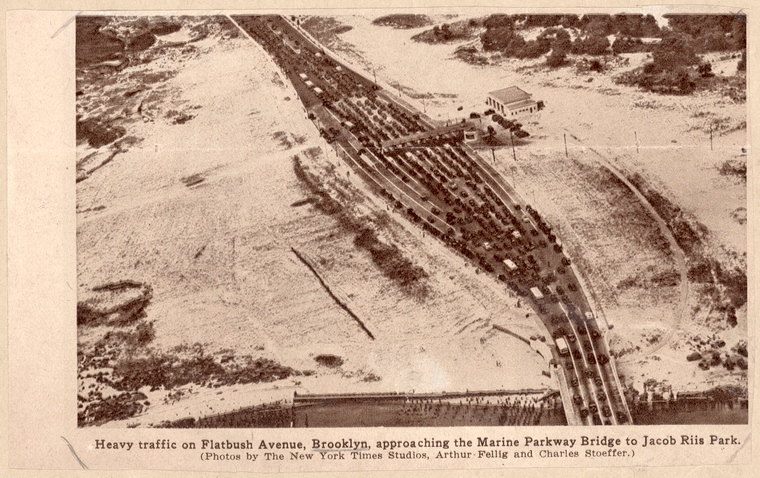
Jacob Riis Park, near the west end of the Rockaway Peninsula, was planned in the 1910s and opened in 1932, but didn’t really become popular until the Marine Parkway Bridge was opened in 1937, extending Flatbush Avenue over the Rockaway Inlet (which connects Jamaica Bay to Lower New York Bay). The bridge made it easy to drive from Brooklyn to the park, when there was no easy mass-transportation access. The Rockaway Beach Branch of the Long Island Railroad (now the Rockaway branch of the subway A train) ends more than a mile to the east. And here’s the result:

It’s a nice park and I’m glad it’s there. It would be a better park if it were easier to get to. One could argue that the construction of a public amenity like this should have been accompanied by an extension of the railroad that one mile plus, or, even better, an extension of the IRT subway down Flatbush Avenue, which would serve Floyd Bennett Field and the large neighborhood of Flatlands. But that’s not the way people were thinking in the 1930s.
You must be logged in to post a comment.