

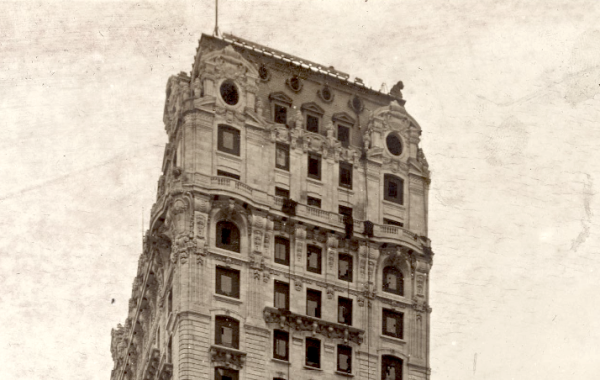
From the New York Public Library scrapbooks, a page from 1918 showing the Hotel Marguery on the west side of Park Avenue, between 47th and 49th Streets. The building’s address was 270 Park Avenue.

That odd two-wing configuration is what happens when you plan a building around a street, in this case Vanderbilt Avenue. Vanderbilt was added to the regular street grid (it’s roughly Four-and-aThird Avenue) in an effort to ameliorate the disruption from Grand Central blocking Park (Fourth) Avenue. This photo was taken when there were still open lots (on the left, for example) in the air rights over the approach and train yard north of the station.

Despite the name, this was an apartment house. Until the New Tenement Law was superseded by the Multiple Dwelling Law in 1929, there were only two major categories of multiple dwelling in New York: tenements and hotels. A lot of high-end apartment houses were classified as hotels, and therefore had closet-sized “pullman” kitchens.
In any case, it didn’t last long. As most of the city’s office-based businesses moved from downtown to midtown, the high-end residential district that had been created on the Grand Central air rights was demolished one building at a time. The first to go was the Marguery, demolished in 1957 and replaced by the 52-story Union Carbide Building in 1960. When that building was constructed, it demapped the block of Vanderbilt Avenue passing through the site; Vanderbilt’s importance had been greatly reduced when the Park Avenue viaduct was completed in 1928, allowing the avenue to run around the train station. Union Carbide lasted a bit longer. It was demolished in 2021 for the 1388-foot new 270 Park, currently in construction.
Sic transit…

You must be logged in to post a comment.