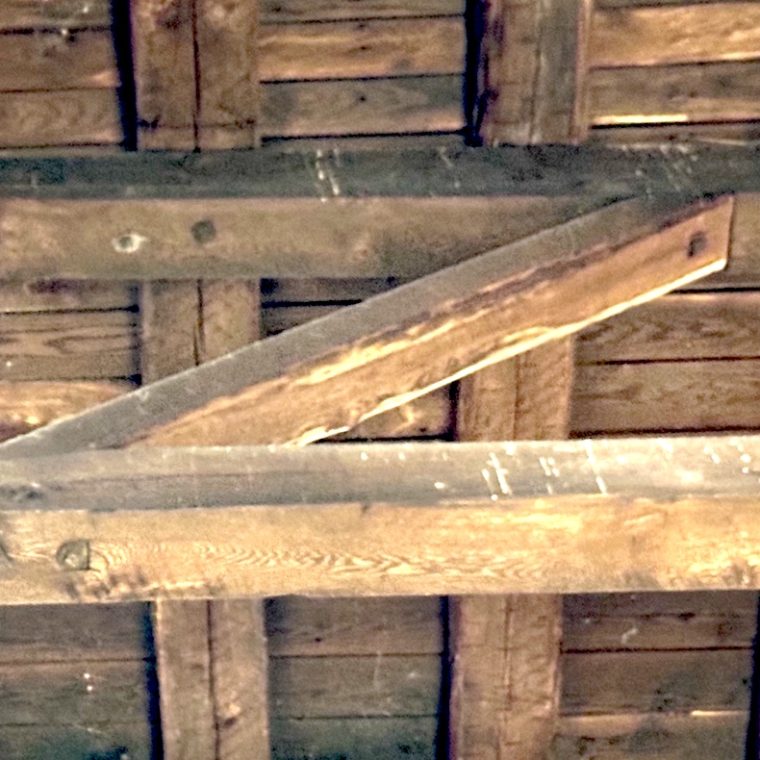


Howe trusses look backwards to me. Structural logic generally says that compression members should be stockier than tension members because, while the gross stresses are the same (force divided by cross-sectional area), compression members may buckle and tension members will not. If a truss has square panels (i.e., the verticals are spaced the same distance apart as the top and bottom chords), then the diagonals are longer than the verticals by a factor of the square root of 2…let’s call it 40% longer for simplicity. Pratt trusses have compression verticals and tension diagonals, so the compression members are shorter, which feels right. Howe trusses have tension verticals and compression diagonals, which feels wrong.
If you’re building your truss entirely of the same members – wood 8×8s, for example – the difference between tension and compression lengths may not matter much, as the members will be reasonably stocky regardless of that 40% additional length. But if your member forms are based on the forces, it does matter. In late-nineteenth-century steel trusses, the compression members were often built-up boxes while tension members might be flat eye-bars. In the early nineteenth century, people figured out they could substitute iron rods for the tension members as way to simplify the wood joinery at the joints. Iron rods as compression members would not work for at least two, and probably more reasons (the joints used, imprecision in layouts creating secondary bending stresses), so which way you ran your rods was a visible indication of which way you analyzed your trusses.
So, I started this post with the intention of going against my instincts and saying something nice about Howe trusses. Here it is: look at how simple the vertical-rod connection to the lower chord is. Just a washer and a nut. Since there’s no angle to the rod, there’s no need for an angled washer or a bird’s-mouth cut in the wood.


You must be logged in to post a comment.