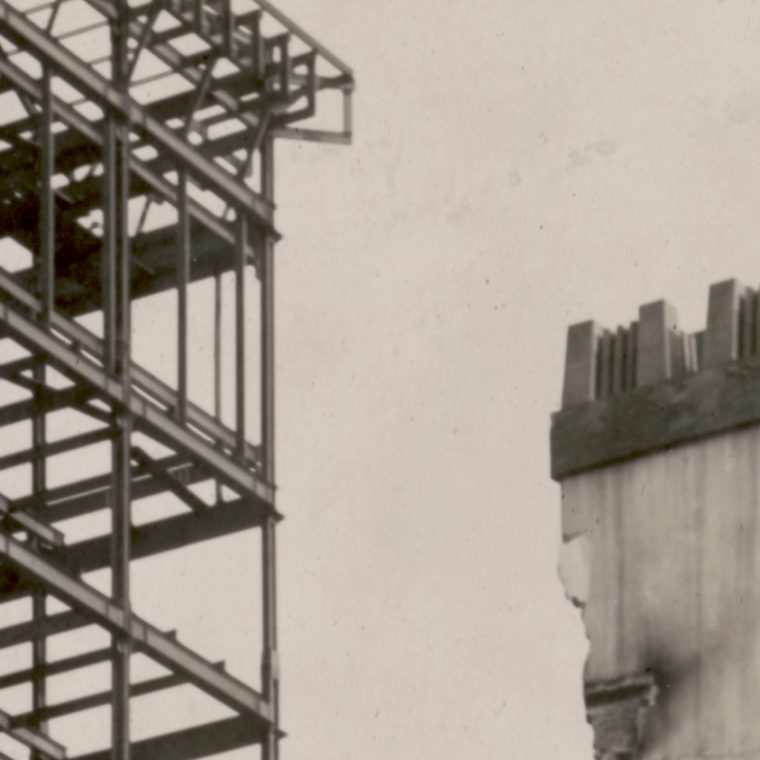

A photo from San Francisco, some time in late April 1906:

In the foreground, the ruins of an eight-story bearing-wall building; in the background the bare steel frame of an unfinished 13-story building. The frame looks pristine, although there may be damage not visible from this distance. It’s not actually clear what destroyed the foreground building: we can see enough of its interior structure to know it had steel1 beams supporting its floors. Presumably the beams supported a “fireproof” floor system, of which the most likely would have been terra cotta tile arches.
That earthquake was the largest in recorded history in the area, but a lot of the damage to the city was the result of uncontrolled fire afterwards. Water mains were broken, severely limiting the fire department’s ability to respond; the over-turning of wood- and coal-burning stoves, and coal-fired boilers, and broken gas lines started numerous fires simultaneously which would have probably exceeded the ability of the fire-fighters to address the problem even if they had water. Most of the damage to the city was caused by fire.
If you look at the short piece of wall parallel to the plane of the picture, between the surviving front facade on the right and the first line of windows on the missing wall running right to left, you see severe scorch marks. There was a fire here for some time before the interior floors collapsed, because in its current state there is no way for a fire to burn above the first floor. This building was likely damaged by the quake: all of the fireproof floor types that might have been present are heavy, and seismic events load buildings through their own mass. The building is relatively slender in the direction parallel to the front facade, and so shaking in that direction would have been damaging.2 My guess – and it is a guess – is that the long side walls were out of plumb after the quake, and so were particularly vulnerable to collapse when fire reduced the bracing provided by the floors.
The bare frame, by contrast, was less likely to be damaged in three critical ways. While slender, it weighs little3 and so would be less heavily loaded by the quake than a completed building; steel is ductile, so the frame may have experienced a lot of sway that would have damaged its future masonry walls had they been present; and there’s nothing there to burn.
You don’t usually get such a clear side-by-side comparison.
- Or maybe wrought-iron, but that distinction does not matter for this discussion. Which is why it’s in a footnote. ↩︎
- But note that the front facade is intact. It was apparently strong enough to withstand whatever shear loading the quake induced. The rear facade is partly intact as well. The interior of the building, lacking any cross-walls, may have moved more. ↩︎
- “Little” on a structural scale. I wouldn’t try to lift it. ↩︎
You must be logged in to post a comment.