
My off-hand comment yesterday about a Baedeker guide made me think that I should look to see what a nineteenth-century European guidebook had to say about New York and I was not disappointed. The guidebooks put out by the Baedecker company since the 1830s are famous for their detail and accuracy, and the 1890s might be argued to be near the peak of their influence. So here are a few excerpts from “The United States, with an Excursion Into Mexico: Handbook for Travellers” published in 1893. Note that it was republished in New York by Scribner:

I could honestly pick this book apart for weeks, but I’ll try to limit myself. (Fritz Baedeker, the fourth member of the family to run the firm, was apparently the editor, despite the fact that the preface says it was his brother Karl – Wikipedia say that “in 1877 (according to the source cited here) Karl, afflicted with an incurable mental condition, moved to a sanatorium near Esslingen am Neckar where he remained for the rest of his life.” Maybe Wiki is wrong and Karl edited this volume.) The preface states “No one is better aware than the Editor himself of the imperfections almost inseparable from the first edition of a guide-book; and the vast extent and rapidly changing conditions of the United States have made the preparation of the present volume a particularly difficult task. For its improvement, however, he confidently and gratefully looks forward to a continuance of those valuable corrections and suggestions with which travelers have long been in the habit of favouring him. Hotel-bills, with annotations showing the traveller’s opinion as to his treatment and accommodation, are particularly useful.” I.e., crowd-sourcing.
Just the first page of the table of contents is a trip:

Close to 100 pages of background before you even get to the tour. To give a sense of the background, from page L: “The larger cities especially have in most cases fallen into the hands of unscrupulous gangs of adventurers, commonly known as Rings, who monopolise the offices and emoluments, job the contracts for public works, incur large debts for the city, and in some few cases enrich themselves by plundering the public funds, while occasionally securing impunity by placing their creatures and dependents in judicial posts.”
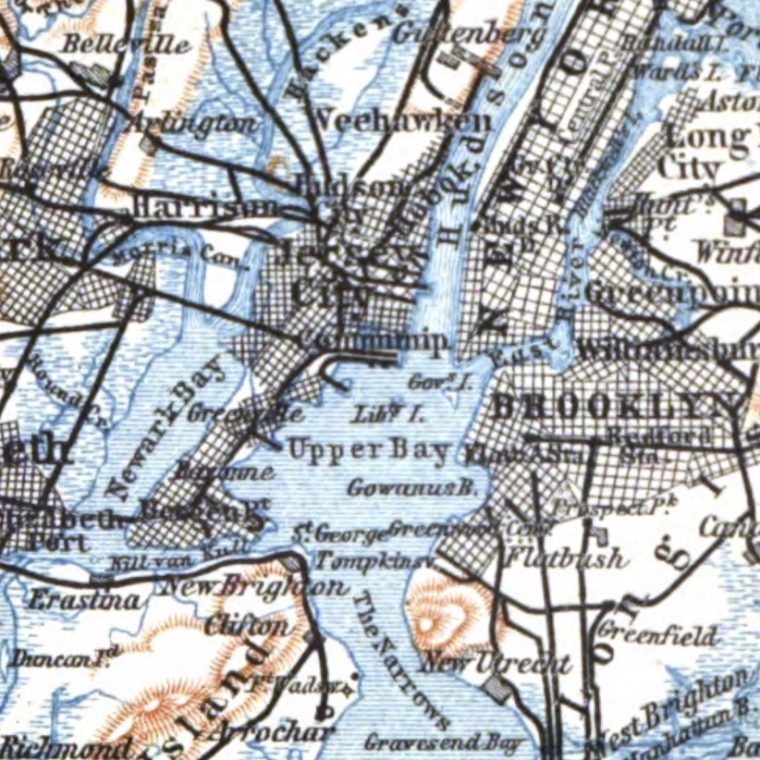
I’ll close out this post with a beautiful map of railroads in the NYC area. Note that one of the lines shown in Staten Island and several in Brooklyn later became parts of the subway system, and that in 1893 the portion of the Bronx west of the Bronx River had already been absorbed into the city.

You must be logged in to post a comment.