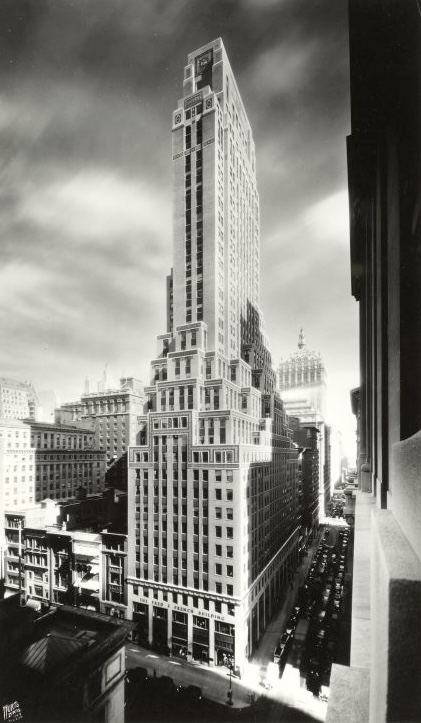

From, probably, the 1930s, the Fred F. French Building at 551 Fifth Avenue, corner of 45th Street. (I doubt that it was intentionally made a tongue-twister, but that’s a lot of Fs.)

I’ve previously defined “vernacular” as what people build when they can’t think of something else to build. And that idea led me to the brink of saying that New York has a skyscraper vernacular. I feel like the FFF Building is a good example of the skyscraper vernacular as it existed in New York in the 1920s. It’s worth starting with French himself: he was a relatively small-scale developer most famous for two apartment complexes: Tudor City in Midtown and Knickerbocker Village on the Lower East Side. He died fairly young, and might well have continued building his empire had he lived past the effects of the Depression.
The FFF Building was, like most corporate headquarters in New York, mostly a rental building. French certainly did not need more than 400,000 square feet of space to house his company. So, first, the use is pretty much generic for its type.
The overall form is very much an expression of the 1916 zoning law. If you look at the left side of Stage 4 Hugh Ferris’s famous set of illustrations showing the effect of the zoning law on design, the familial resemblance to FFF is, I think, quite clear.

So, second, the form is pretty much generic.
The facade is not quite plain: it could have been just brick with maybe some minor terra cotta ornament; instead there is a rather exuberant mosaic at the top, visible to birds and people in nearby offices. If you want color photos: here.

But heavily-ornamented terra cotta was quite common back then, if not necessarily as heavy as that mosaic. So, third, I’ll make the argument that the brick and terra cotta facade was ordinary for the era.
I could stop there, but I’ll throw in one more. Despite the good-looking architecture of FFF – it’s an exterior and interior landmark – it’s not famous except among skyscraper geeks. It’s not big enough, or located prominently enough, or architecturally distinctive enough to catch people;’s imagination. And isn’t “background building” part of “vernacular?”

You must be logged in to post a comment.