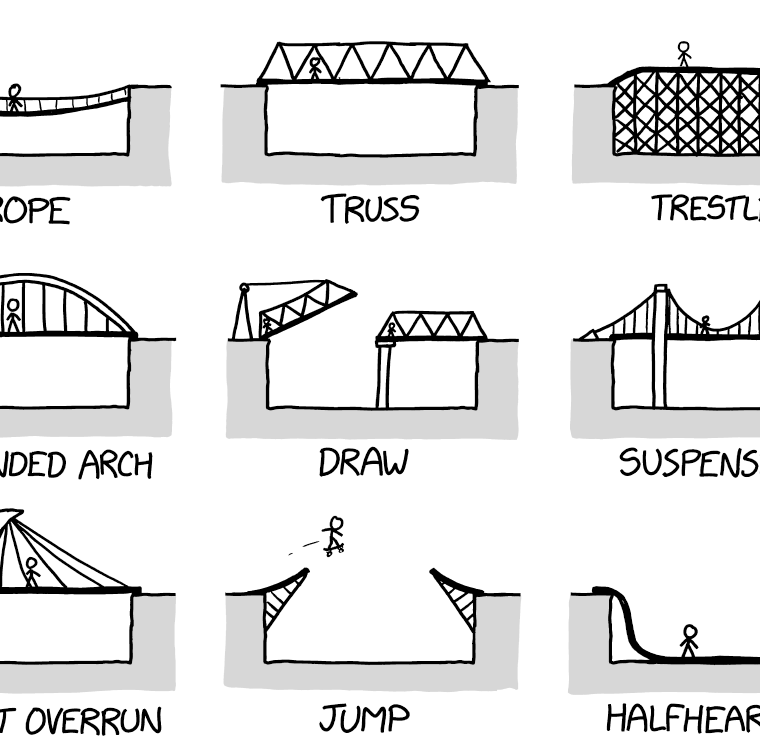

How much time should I invest in trying to explain a joke that I didn’t make?
The starting point is this xkcd cartoon:

The four bridge types in the first row are all pretty straightforward and accurate. I beat trusses bridges into the ground here a few years ago, and I’ve talked about everyone’s favorite trestle.
The second group of four has a bit more to quibble about. I’d call the “arch” a viaduct and the “suspended arch” a bowstring, but maybe I’m being too picky. Given the ability span long distances with suspension bridges, it would make more sense for the towers to be on either side of the gorge rather than founded at its bottom. But these four still basically make sense.
With the third group, we’re clearly into the jokes, although people have certainly used the “filler” method in real life. I’ll come back to the “cost overrun” as that’s the one that bothers me.
The fourth is more fantasy than joke, although maybe its both. I fear for the ability of the fish to breath inside the waterbed, and I have no idea if the “L’Engle” reference was widely understood. “The repurposed elevator” is fascinating in that it reveals how Randall Munroe, the author and illustrator, sees elevators. Most people think about the cab, but he’s thinking about the shaft as the defining entity.
Back to my obsession, the cost overrun. It looks wrong to me, and it took a while to figure out why: if you’re building an asymmetric cable stayed bridge, it’s usually easier to balance the forces if the tower is leaning backward, away form the main suspended span. Leaning it forward means the tower’s own weight is pulling it in the same direction as the sum of the cable forces. There are many asymmetric cable-stayed bridges with vertical towers and a few with forward-leaning towers, but none that I found that look particularly like the illustration. Maybe he just drew it, maybe he’s got a specific bridge in mind. I’ll never know.


You must be logged in to post a comment.