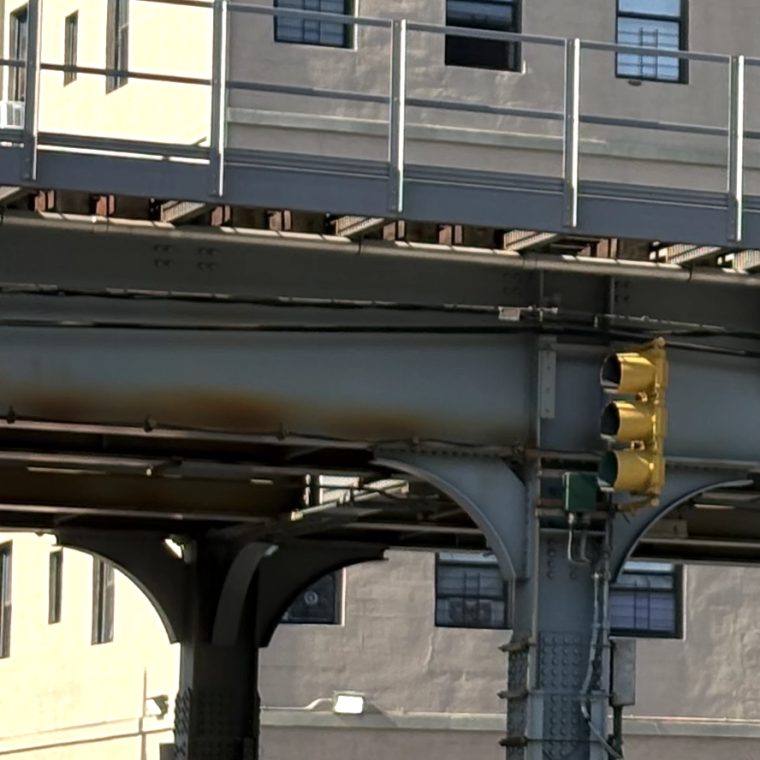

From a recent site visit nearby, the Long Island Railroad elevated over Atlantic Avenue in Brooklyn:

The wikipedia history of the LIRR is one of the longest articles I’ve ever read there, and mind-bendingly complicated. There are two reasons for the complications. First, despite the relatively small territory (about 15 miles wide at the widest and about 120 miles long), railroads (and later highways) on the island had to deal with commuter traffic into downtown Brooklyn and Manhattan, beach and excursion traffic the other way, long-distance travel (for a long time, there were plans to use the Long Island route as a way to go from New York to Boston), and freight for various industries. Second, because of the nineteenth-century belief that railroads, particularly in and around New York, were a sure path to wealth, new roads kept getting established and, eventually, bought out by the LIRR. The LIRR itself was bought by the Pennsylvania Railroad behemoth in 1900 to facilitate the construction of Penn Station: there was no way to acquire enough land in Manhattan to build a yard for the station, so the yard was put in western Queens, and connected into the LIRR system. This also gave the eventual route to connect to the New Haven Railroad and New England via the Hellgate Bridge. (Lost yet?)
The line from Brooklyn to Jamaica is the original Long Island Railroad, opened in 1836 and running from the waterfront (Brooklyn’s South Ferry at the foot of Atlantic Avenue, not to be confused with Manhattan’s South Ferry) in an almost straight line along Atlantic Avenue to the Jamaica station. When Brooklyn banned steam locomotives from operating within the city limits in 1851 (some 50 years before New York did the same), the LIRR converted the Brooklyn branch, which ran at grade, to horsecar service. People coming from the east would get off the steam trains that either terminated at Jamaica or went due west to the Queens ferries on the East River, and switch to horse-drawn streetcars. In 1877, Brooklyn allowed steam trains back, and a new terminal was built at Atlantic and Fulton Streets. In 1897 the city of Brooklyn (absorbed into New York the next year) ordered the removal of all 50 grade-crossings on Atlantic Avenue. This order fit well, after 1900, with the PRR staff’s general belief in eliminating at-grade tracks within cities, and the new Atlantic Avenue branch – part in tunnels and part elevated – opened in 1903.
So that very heavy elevated structure in the photo above was designed and built to the standards of the Pennsylvania – considerably more rigorous than those of the LIRR – about 120 years ago. If you closely, the structure is quite simple: there’s a cross-girder connecting each pair of columns, and four beams running girder-to-girder. Each beam is directly below a rail, so trains overhang the main steel structure, which can be disconcerting if you’re next expecting to see it.
You must be logged in to post a comment.