

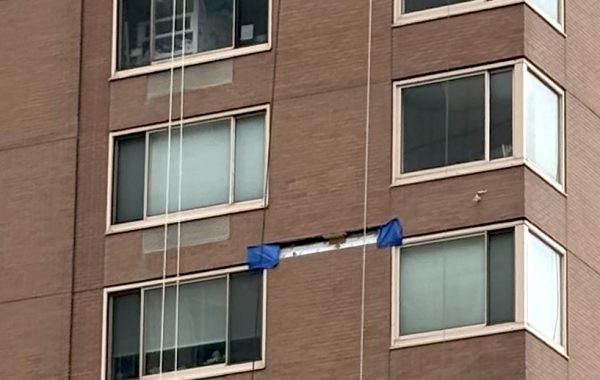
This picture has been circulating a lot the last week or so. I’ve seen it posted on LinkedIn by three different people and it was recently emailed to me by an architect.

What you’re seeing: there used to be a window at the lower floor that was the same width as the window above (where we see just the sill). You can see the brick flat arch that was the head of the old window. Someone has expanded that window to the right, making it wider, and installed a wood plank as a lintel. That lintel has deflected quite a bit, allowing the masonry above the lower window to sink downward, opening up several step cracks.
First: Don’t do this.
Second, let’s discuss the difference between strength, of which we have two examples immediately adjacent to one another. The plank appears to be strong enough to hold the masonry load – there’s no visible crushing or splintering – but it’s obviously not stiff enough. The standard in the US has long been a maximum deflection of L/600 for lintels supporting masonry, which for this window would mean that the allowable deflection is about 1/8 of an inch. I doubt you’d be able to clearly see a defection that small in this picture. The second example is the flat arch which, despite losing its lateral support on the left because the entire arch has rotated down to the right as the lintel moved, is still spanning and has retained its slight upward curve. It’s both stiff and strong.
Third, lintels are designed for a triangular load from the masonry above – depending on who you believe, using a 45-degree angle on each side or a more conservative 60-degree angle – based on arching action. In this case, you can see the triangle formed by the lintel and the diagonal cracks: the masonry above the crack has moved less. I suspect the masonry above the lower diagonal cracks would not have moved at all if not for the presence of the upper window, which interrupts the line of force for the arching action. The height of the load triangle (which is the same as the height of the “invisible arch” that makes up the arching action) is proportional to the opening width, so the arching action for the original window (i.e., the masonry above the triangle supported by the flat arch) easily passed below the upper window.
Finally: Don’t do this.

You must be logged in to post a comment.