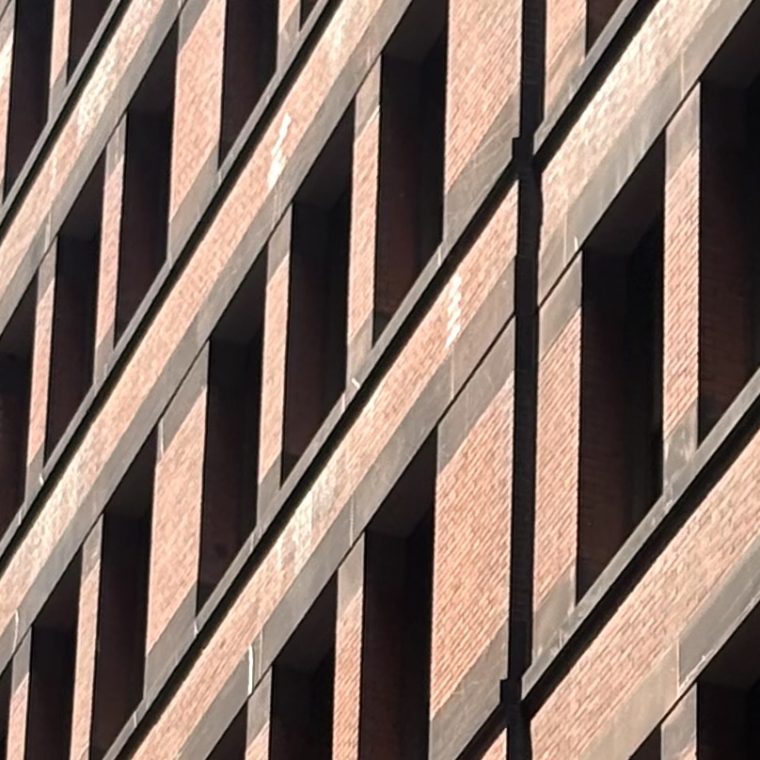

A view of the south end of New Street, looking south:

New Street was inserted a very long time ago to break up the blocks between Broad Street and Broadway to more manageable depths. It feels like a back alley, partly because it is 40 feet wide, compared to Broad’s 85 feet and Broadway’s 70 feet.
The green glass building, Two Broadway, is south of Beaver Street, where New Street ends. The red brick facade on the right looks very heavy – without thinking about what building it is, my first thought was “bearing wall” – especially compared to the lighter-colored limestone facade to its left. The fancy detailing of the stone facade, particularly the arches at the base, made it clear what building that is: the Standard Oil headquarters at 26 Broadway, which wraps the corner onto Beaver Street.
There’s a curiosity: the windows in the red brick facade exactly line up with those in Standard Oil. Even in an era when architects tried to align their cornices with their neighbors, they made no effort to align floors…unless there was a reason to do so. Here’s the current lot map, courtesy of the NYC Department of Buildings:

Note the narrow building that fills the lot at 32 Broadway/69 New Street. The Grotto Pizzeria and El Toro Mexican Grill in the first picture are both in 69 New Street. So the red brick facade is part of Standard Oil. Looking at 1923, Standard Oil has the same overall footprint as today but is quite clearly divided in two, with a shorter north half separated by an interior wall from the taller south half:

Standard Oil was constructed in those two halves, with the north part coming first. Looking back at my notes for The Structure of Skyscrapers, the north half was a bearing-wall building constructed in 1886 and expanded and partly rebuilt with a steel frame in 1899. The south half was constructed piecemeal 1921 to 1928, including altering the Broadway facade of the north half to match. The north half is visible in its current configuration in 1911:

Compare the south wall of the Standard Oil building in that last map to the interior wall in 1923. The Welles Building was another early skyscraper, running in an L shape from 14-20 Broadway to 5-7 Beaver Street. Welles, the two small buildings at 8-12 Broadway and 1-3 Beaver Street, and the building at the corner of New and Beaver Street were demolished for the 1920s Standard Oil expansion. The red brick facade in my photo is the back of the north half of Standard Oil, mostly dating to 1886 and therefore some forty years old when the south half of the building was finished.
You must be logged in to post a comment.