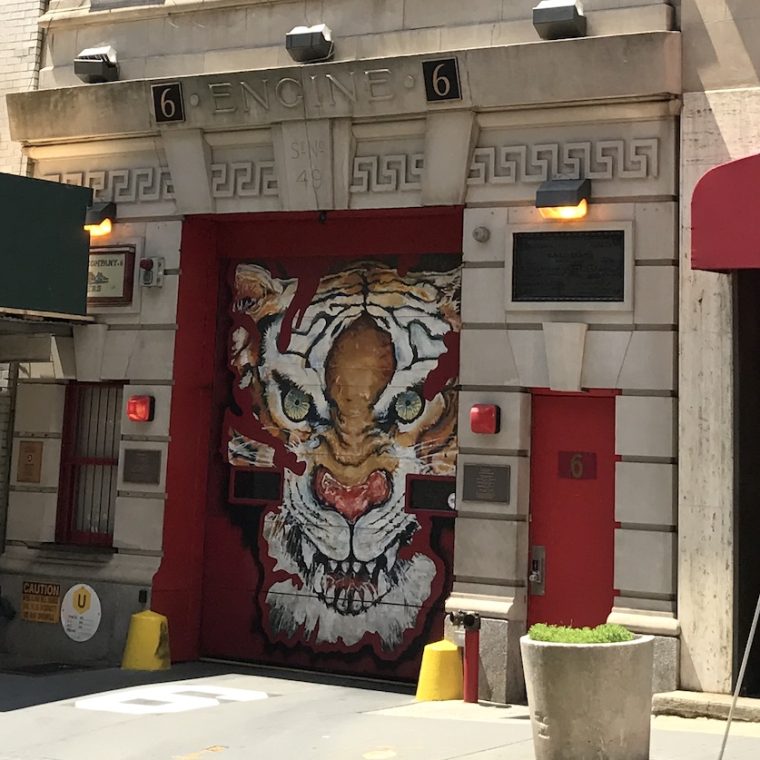

While looking for something else in my old photos, I found this one from 2017: the Fire Department of New York, Engine Company 6 on Beekman Street:

First, yet another beautiful old fire house. The architects were Horgan & Slattery, a politically-connected firm most famous for the Surrogate’s Court building on Chambers Street.
Second, the building was constructed for Engine Company 32, and if you look over the doors, you’ll see that the words “Engine Company” are graven in stone, while the number “6” is on a metal plaque added to hide the “32.”
Finally, let’s address the elephant tiger in the room. That is some mural on the door and it’s the reason I took this photo…not because I was wondering what that meant but because I know where it came from. Prior to 1865, New York’s fire-fighters were volunteers, organized in companies that competed for work and glory. Engine Company 6, after some early difficulties, was reorganized in 1848 and became known as both the Americus Company and the Big Six. One of the leaders was a rising young businessman and politician named William Tweed. In 1850, when he was 26, he became the leader of Engine Company 6. The engines of that era were pulled by the fire-fighters by hand and the “engines” were hand-pumped.

Only after the creation of the professional fire department in 1865 did horse-drawn trucks with steam-engine pumps become standard:

Back in the 1850s, Engine Company 6 had a tiger’s head painted on the truck as their symbol. In the early 1870s, when Thomas Nast was taking part in a press campaign against the entrenched power of Tammany Hall in NYC’s politics, he seized upon the tiger as a symbol of not just Tweed, but the entire political machine

In other words, yes, the tiger has a 170-year association with Engine Company 6, but there’s a bit of baggage as well.
You must be logged in to post a comment.