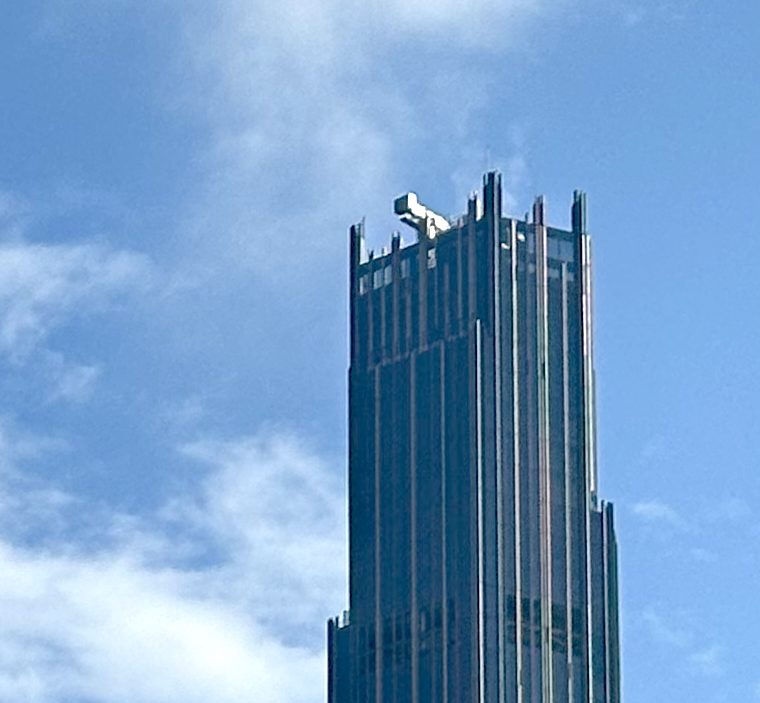

Walking down the street in Brooklyn and, wow:

I’m not particularly a Tolkien fan, but it’s hard not to make a bunch of Mordor jokes. You’d think that as a marketing promotion, putting an inflatable Eye of Sauron on the roof would help. Even better, attach it to the davit for the window-washing scaffold that you can see above the roof, so it can turn in any direction.
In any case, that’s the Brooklyn Tower, formerly known as 9 DeKalb Avenue, Brooklyn’s first supertall. And unlike the vast majority of tall buildings in the city, there are angles from which it stands alone in the sky. (The best angles are from the north and south, because if you look form the east or west it gets lumped in with downtown Brooklyn and the new buildings along Flatbush Avenue Extension.)
There are two ways to appreciate skyscrapers as objects on the skyline (there are, of course, many other ways to view them architecturally, technologically, and socially): as free-standing pylons or as trees in a forest. In a lot of cities, the first tall buildings have been viewed free-standing, and as more are built that idea is abandoned for the forest. This process continues today: when I first visited London in 1990, I was able to navigate a fairly large swathe of the central part of the city by using the BT Tower as a guide. That’s no longer possible in many of those areas because of the forest that has grown up since then. Seeing Brooklyn Tower like this is a throwback to an earlier era.
You must be logged in to post a comment.