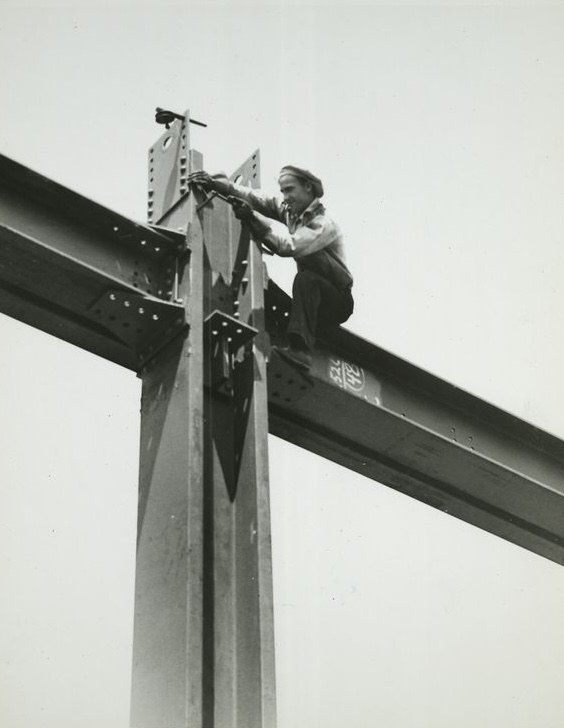

From Lewis Hine, “Plumbing up a column” at the Empire State Building:

First, as with nearly all of Hine’s photos, what a work of art. Second, I’m not sure if that’s a beret as a particularly stylish way to not have a hard hat, or if it’s a flat cap worn backwards.
Nothing that steelworker is doing looks like a plumbing a column, which was typically performed at the Empire State – as with most steel frame buildings of that era – by using steel cables as temporary bracing that could pull columns into their proper verticality. It’s possible that he is working on an attachment point for a cable, as the first step to plumbing.
The girder he’s sitting on, and the one directly opposite, have moment connections to the column made of top and bottom Ts. The girder end shear is taken by a connection from the girder web to what might be another T or might be a built-up bracket (it’s hard to tell from the relatively low-resolution photos from the NYPL web site). The beam that will someday be fastened to the column web has a stiffened-seat connection for shear and probably moment as well: there appear to be empty rivet holes in the column web for a T or L top-flange connection to come.
It is clear that the rivet holes from the top and bottom Ts to the girders are empty, as are all of the visible rivet holes in the web connections. That makes sense: to be able to change the angle of the column, you want the connections to be loose; since there’s no way to install a rivet and tighten it later, you simply omit as many rivets as possible until the column has been plumbed.
Them as now, shop connections were cheaper and had fewer quality-control issues than field connections. The three pieces of each girder connections, the stiffened seat of the beam connection, and the splice plates at the top of the column section all came to the field already riveted to the column, so only about half of the rivets had to be driven on site.
You must be logged in to post a comment.