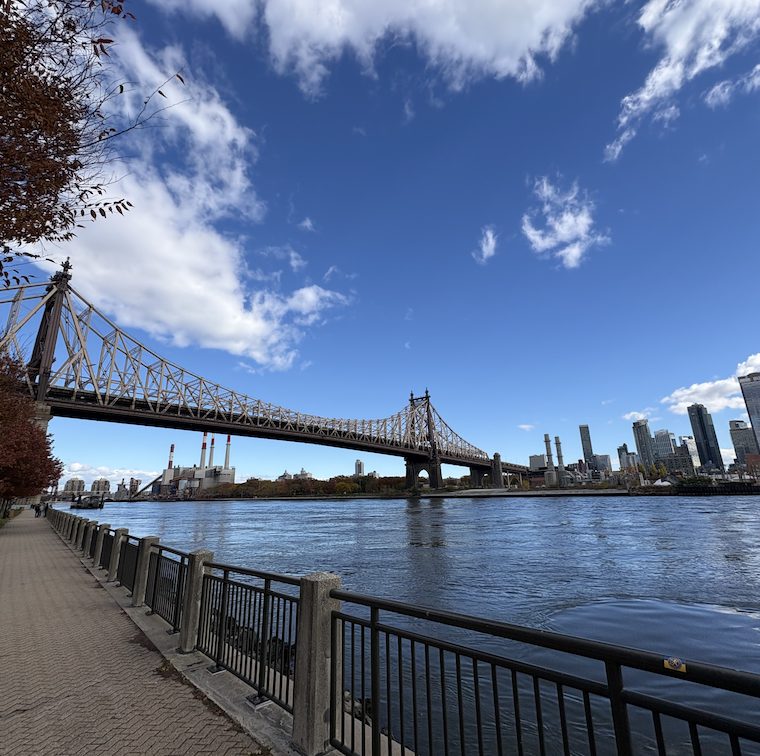

I was on Roosevelt Island a few weeks ago and got some nice pictures of the Queensboro Bridge. The Queensboro is an outlier among New York City’s bridges in several ways: it’s a cantilever truss, it’s asymmetrical, and it doesn’t clear-span the river it crosses. The Queensboro has a tower in Queens, one in Manhattan, and two on Roosevelt Island, which divides the East River, for a stretch, more or less in half.
First, my walk from south of the bridge toward the ferry pier on the east side of the island a bit north of the bridge:


It used to be very simple to distinguish which side of the island you were looking at by looking at the background: if there were high-rises, you were looking at Manhattan; if there weren’t, you were looking at Queens. The explosive growth of Long Island City in recent years has changed that: those new Queens high-rises are what you’re seeing across the half-river.
Then I was close enough to get a good view of the eastern Roosevelt Island tower and the truss:

The masonry is not just for show, but I’m not sure of there’s any steel in it or if the bottom half of the towers is masonry-only. It’s easy to pick out the truss members intended for tension only, which are groups of eye-bars, from those intended for compression or alternating compression and tension, which are built-up boxes. The parts that look solid in the photo are the sides of eye-bars; the boxes are visible as lattices. The upper tower legs are much heavier, solid-wall boxes.
One things that’s missing in this view is the lower chord of the truss. The eye-bars that make up the upper chord are clear, but the web diagonals and verticals all sort of hide behind the cantilevered structure of the outer lane of roadway.
Then I got under the bridge:

Zoomed-in:

The big double-box lattice is the lower chord of the truss. The solid parts are where the connections to the web members are above, and the same locations are used for the connections of the horizontal wind-bracing. This angle also makes clear the gang-of-eye-bars nature of the upper chord and some of the diagonals.

You must be logged in to post a comment.