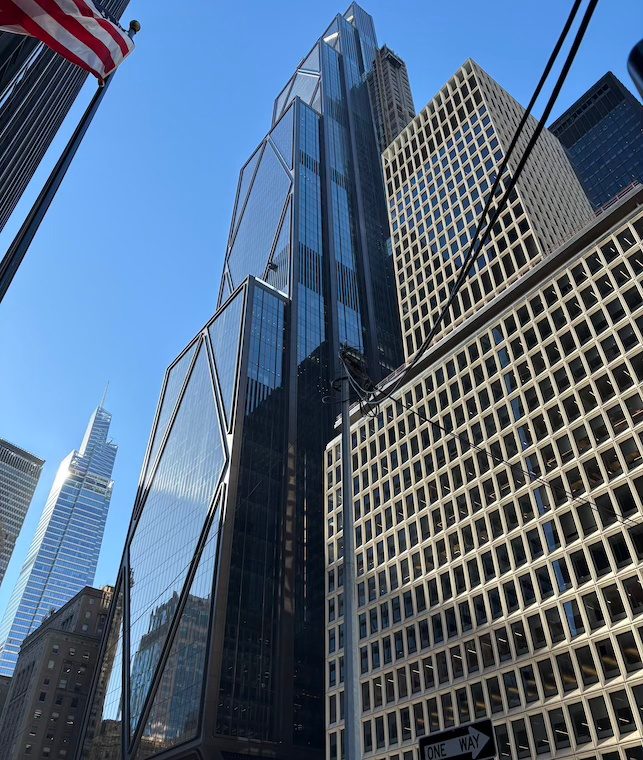


I frankly enjoy a good savaging by a critic1, whether I agree with it or not. There is something deeply satisfying about a well-constructed and well-written assault.2 I say this in the context of yesterday’s publication by the Guardian of “An eco obscenity: Norman Foster’s steroidal new skyscraper is an affront to the New York skyline” by Oliver Wainwright. I’ve written about this site and its history before, twice. I was on Park Avenue a few weeks ago and took a series of (banal) photos of my view of the building as I progressed northward from the pedestrian path through 230 Park Avenue, at 45th Street:


A few stats to put the following discussion in perspective: The new building is a super-tall, at 1388 feet; it’s 60 stories high and has 2,500,000 usable square feet of space. The old building, constructed for Union Carbide and opened in 1960, was 52 stories and 707 feet high, and encompassed 1,500,000 square feet. The lot for both is the full block between Park and Madison Avenues, and 47th and 48th Streets.
Mr. Wainwright’s arguments fall into several categories and are worth separating. First, and most obviously3 he discusses at some length the ecological issues with constructing the new building. This is a legitimate concern – and one that I have discussed in other contexts. There are two aspects to it: the new building wastes a lot of interior volume on grand spaces: 60 stories in 1388 feet is an average of 23 feet per floor, roughly twice my mental estimate for an office building. As Mr. Wainwright correctly points out, all that volume has to be heated and cooled. The bigger question is whether the building was needed at all. New York has been on a growth spurt for decades, mostly fueled by white-collar business and support services for white-collar business, and I’m willing to listen to an argument that the net gain of a million square feet that came from replacing Union Carbide with the new building was needed. That leads to the interesting question of where that million square feet came from if the new building only has eight stories more than the old one (even if it is twice as tall). The answer is to look to the west…specifically the west half of the lot. Union Carbide’s 52-story tower was only the east half, facing Park, with a low-rise annex on the west, facing Madison. The new building is more or less symmetrical and so has far more bulk on the west side of the lot. This suggests that the old tower could have been kept and the annex demolished and replaced with new, taller construction. It might not have resulted in quite as much square footage, but ti almost certainly would have provided the bank with enough office space, while keeping an important old building and greatly reducing the environmental impact. But, of course, part of the program that was given to Foster and Partners by the client was to create a super-tall, which is one of the few ways to get noticed on the New York skyline in 2025.
The amount of steel used in the frame is large, as one would expect in such a large building. If you accept the presence of the building at all (see above) you can debate whether there would have been less pollution if it had an entirely reinforced-concrete frame. It seems that some of the weight of steel has to do with architectural design decisions: the high floor-to-floor heights, maybe the geometry of the setbacks, and the desire for column-free space. The last escapes my understanding entirely: people talk about column-free space as if it’s an obvious and desirable goal, and I have no idea why. Building interiors have been designed around columns as long as there have been buildings, and unless it’s a theater or arena or other space where sight-lines are critical, getting rid of columns seems like a stunt.
About the LED-lit crown…opinions differ. Mr Wainwright: “Every evening, for miles around, New Yorkers can now gaze in wonder and horror as the tower’s summit transforms into a glittering crown, bubbling with twinkling lights that rise up the facade like a supersized flute of champagne….Sometimes, the throbbing diamond shape adds an inescapable Eye of Sauron vibe. At other moments, it appears to shift into a pulsating yonic void.” On the other hand, Nicholas Mancall-Bitel at the New York Times: ” New York’s Skyline Has a Bold New Look.”
Mr. Wainwright pretty clearly does not like the building’s style, particuarly when compared to older skyscrapers. As it happens, I agree with him, but the lack of a city-wide governing aesthetic is, in my opinion, one of New York’s strengths. We have mixed nineteenth-century low-rise masonry, early twentieth-century high-rise masonry, late twentieth-century metal and glass, and current-day “Iconography and Electronics Upon a Generic Architecture” with a fair amount of success. That’s a matter of taste and therefore undebatable, but I feel he overstates his case. “This part of Midtown will soon resemble a huddle of bloated bankers squeezed into stilettos, casting ever longer shadows down the canyons of Manhattan and obliterating views of the city’s cherished peaks, while crushing a generation of handsome, usable buildings beneath them.” Has he seen Park Avenue between 45th and 60th Streets? He’s about 60 years too late to be making this argument. Also, for better or worse, New York has made itself – gradually, over the last 160 years – in the image of high-rise density. It’s perfectly okay if he doesn’t like that, but then I have to wonder why he’s writing this review. Years ago, I saw a mediocre production of Hamlet and afterwards read a review where the writer made it clear he hated the play. You can hate the play or love it, but why review a production if there’s no chance you will like it?
There are a few nagging errors. The sale of air rights is not a recent phenomenon related to the Midtown East rezoning. The design of the base is a design choice and can’t be blamed on the need to avoid the Grand Central train yard directly below, as the old Union Carbide Building and the neighboring towers all have their columns threaded through the maze of tracks. The Empire State Building is not taller unless you count the decorative spire and does not have more square footage.4 The phrase “form follows finance” does not apply here: it was created by Carol Willis to describe the phenomenon of tall-building architectural design being influenced by the need to balance rental income against construction and development costs: the extravagance that Mr. Wainwright describes cannot be justified economically (compare to more ordinary office space) regardless of whether it can be justified aesthetically.
I’m going to stop here before my review of the review becomes longer than the review itself. None of the attacks is unfounded and the writing is great. I suspect that a lot of one’s opinion of the review, and the building, will come from one’s opinion of dense skyscraper cities. New York has been one for a long time, while it’s a recent phenomenon in London and not really known elsewhere in the UK.
- Regardless of your feelings about the relative merits of Frank Lloyd Wright and Messers Skidmore, Owings, and Merrrill, FLW’s nickname for them of “Three Blind Mies” is a thing of beauty. ↩︎
- [^4]: My favorite movie review of all time was Michael Musto’s review of Nuts for The Village Voice. It read “Mentl.” I don’t actually remember if his review was longer than that single word; I doubt it matters. ↩︎
- It’s in the headline! ↩︎
- The NYCityMap has an oddly high square footage number for the Empire State. Using the numbers from the Skyscraper museum, 270 Park is bigger. ↩︎


You must be logged in to post a comment.