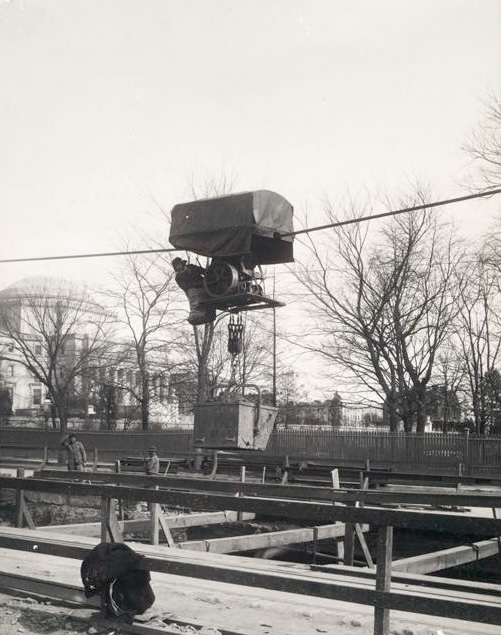

From the NYPL’s “Album of photographs depicting the construction of the Broadway line, New York City Subway” we have, from 1901, “Cable car for taking soil”:

First, location: that’s Low Library (completed 1897) at Columbia University in the background, so we’re on Broadway looking east, a bit south of 116th Street. Columbia’s campus was still sparse on buildings at that time. The timber shoring and deck look much like the cut-and-cover subway construction in the other photos I’ve posted, as expected. But meanwhile, LOOK AT THAT!
Digging soil is conceptually easy, if physically difficult. You need someone with a shovel. If you want to dig faster, you get more people with more shovels, particularly if the trench you’re digging is more than ten miles long. But a person with a shovel is limited in how far they move earth. So how do you get the earth they’ve dug out of the ground out of the way? For example, you can create a chain of diggers, where the first person gets the earth out of the ground and dumps it in a pile to their side. The next person takes it from that pile and dumps it in another pile, and so on. Each digger you add to that chain moves the soil another six feet or so, which is excruciatingly slow from the viewpoint of project logistics, and back-breaking from the viewpoint of the diggers. Enter the cable car!
There are two main components to the car’s movement. The entire car moves left to right along the line of the cable, and the bucket moves up and down. The car is also mounted so it can tip to one side. And, yes, that’s an operator riding it, on the left side. There are a couple of things that are not clear, and if anyone knows about this kind of machinery, I’d love to hear your opinions. First, either the whole cable moves and the car is fixed to it, or the car has an engine and runs along a fixed cable under its own power. In 1901, the possibilities were steam engines and early internal-combustion engines. (To put this in perspective, the first Model T wasn’t for another 7 years.) The lack of any kind of exhaust pipe from under that tarp makes me think the rope moved, but I would have expected a loop of rope so that you didn’t need a big spool to take up the rope at each end, and there’s no second rope (for the other leg of the loop) visible.
We can see a sheave above the hook that holds the bucket, and a large wheel for rope next to the operator, and some gearing. It’s entirely possible that the up-and-down movement was hand-cranked, using the mechanical advantage of gearing to make the load workable. (That raises the possibility that the car moves along the rope by some kind of hand crank as well, which would be bizarre.) Or we’re back to the same question about engines.
The operation would have been: move the car so that it’s near a pile of spoil (shoveled earth), lower the bucket, have a digger fill the bucket from the pile, raise the bucket, move the car to a large spoil pile at grade, dump the bucket by tipping it, and repeat. Since the subway was cut-and-cover, a lot of the excavated soil was put back on top of the completed tunnel. The soil that wasn’t was now at grade, rather than down in the trench, and could be carted away.


You must be logged in to post a comment.