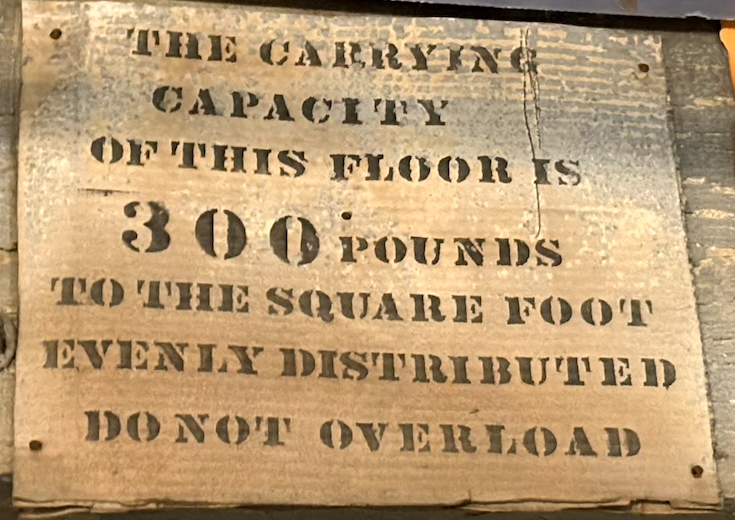

From a factory converted to apartments forty years ago, a sign uncovered by interior removals:

It used to be required to post such signs in industrial buildings, the same way we still post such signs in elevators. Whether or not we can believe the sign is another matter…
Let’s start with the magnitude of load. Concrete weighs 145 pounds per cubic foot (we use 150 pcf for reinforced concrete as the steel makes it heavier), so this is the equivalent of the entire floor being covered in 2 feet of concrete. Or 7-3/8 inches of solid steel. or about 6 and a half feet of paper. So if this were a paper warehouse with alternating shelves and aisles of roughly equal width, you could stack reams of paper 13 feet high. It’s certainly possible, but it’s a lot.
This building was constructed in the 1880s, and the wood in its joists (hidden by the new gypsum board ceiling) and girders (like the one carrying the sign) is denser than modern wood. For wood, density roughly correlates to strength and stiffness, so this floor is likely stronger than an equivalent modern floor. The joist spans are about 18 feet, and the girders about 15 feet; using the strength and elastic modulus values for modern wood and using the sizes of the beams here wouldn’t work, but they might for this older wood. Or they might not. But, of course, these days the required live load for its new occupancy is 40 psf.
One other thought: the past was more empirical than we are today. People sometimes showed that a floor met code requirements through load testing. The problem is that it’s tough to get a proof load of 300 psf in the building. People used sandbags or iron pipe or brick, or some other load that could be readily brought in a little at a time. The problem with those weights is that they might develop arching action (in the sand bags or brick) or simply span by themselves (the pipe) making the floor look stronger than it actually was. Oops.


You must be logged in to post a comment.