
Back to the theme of buildings that are both very old and not old, we’re proud to have been working at Fort Ticonderoga.
In order to understand why three different countries wanted this fort you need to think about geography and eighteenth-century technology. There were few roads in the North American colonies once you got away from the east coast, and the relatively small Appalachian Mountains were a serious obstacle to anyone traveling inland. There was (and still is) a relatively easy route from New York to Montreal: the line of the Hudson River, Lake George, and Lake Champlain. If you used small boats that could be carried across some quite short pieces of land, you had a mostly sea-level water route for that 300-mile trek. Good news for trade, bad news if you were worried about the possibility of the neighboring group of colonists invading.
In 1755, in the middle of the French and Indian War[1] the French army constructed Fort Carillon at the southern end of Lake Champlain, controlling the George/Champlain passage. In other words, it was meant to keep the English south of Champlain. The English army took and renamed the fort in 1759 and kept it garrisoned but not necessarily in good repair, and it was in poor condition by the time the American Revolution started. The nascent American army seized the fort in 1775, the English took it back in the summer of 1777 but effectively abandoned it that fall after their effort to split the American colonies in half along the water route failed at the Battle of Saratoga.
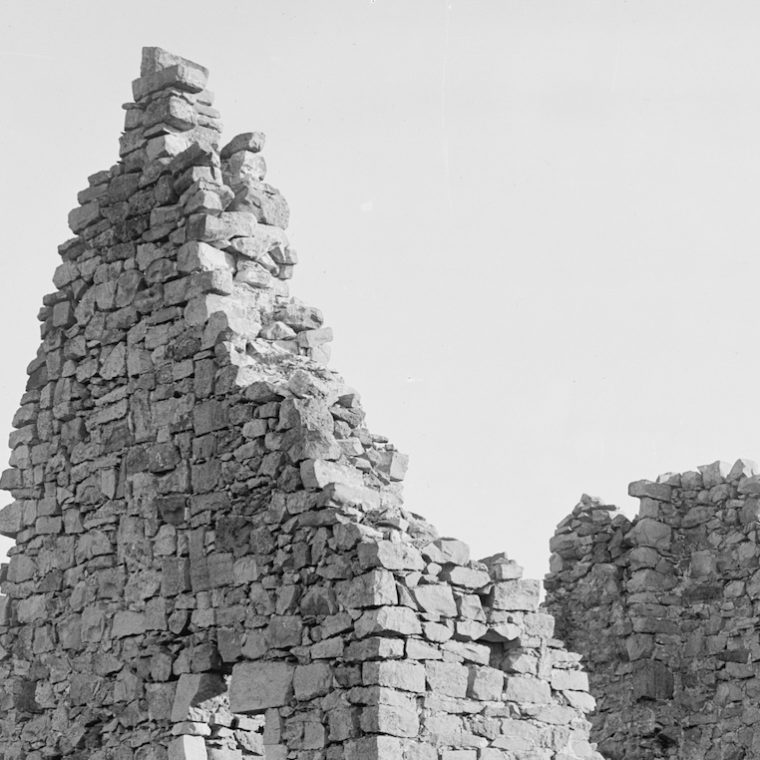
Enough of that, let’s talk physical fabric… Carillon had a wood palisade with an earth berm as its parapet[2] and the French were apparently reinforcing that wall with stone when they were forced out. The English “improved” the fort, but it’s not clear just how much, and anything of value was stripped out in the years following the end of the fighting of the Revolutionary War in 1781. In short, it was a temporary structure that was damaged and altered several times during its short active life. The land was passed form the state to private owners; by 1902, the barracks were in ruins and the parapet was nearly gone:

Restoration of the fort itself and the buildings began shortly after and has never really finished. Here’s the same barracks and section of parapet during the 1934 HABS survey:

So, how old is the fort? We know some pieces of it date to the 1770s and 1750s, but most of the material present is from the 1900s. Because of the history of abandonment and reconstruction there are no modern alterations other than those directly connected to the fort’s current use as a historical monument.
Like this? Then read the “Witnessing the Revolution” series by Cirrus Structural Engineering
- (a) Wars are usually named by the winners, and the English won this one. (b) For Europeans: this was the North American branch of the Seven Years War.↩︎
- Military definition of “parapet,” not civilian.↩︎
You must be logged in to post a comment.