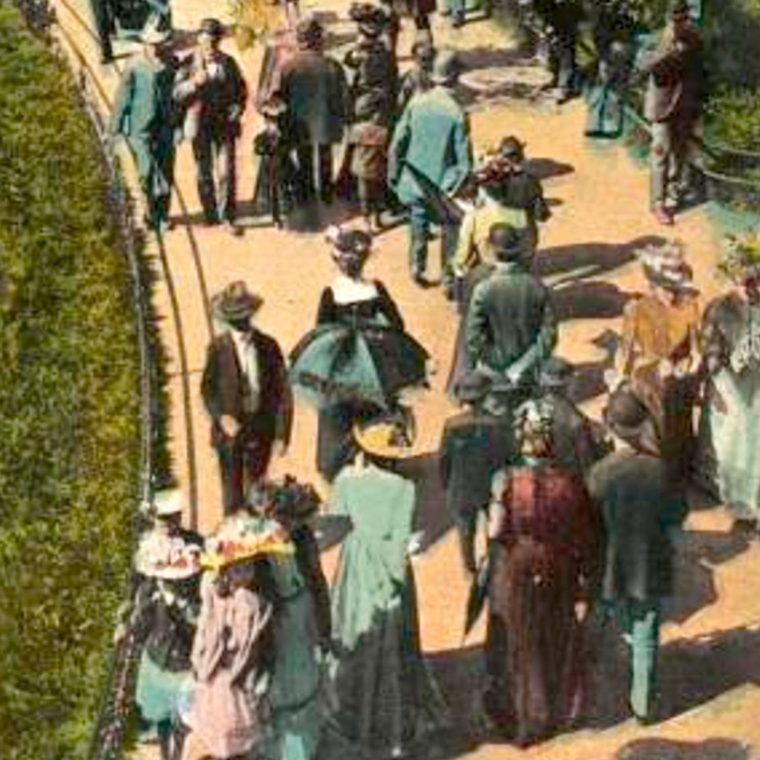

From 1906 or so, a postcard of “Promenade in Central Park”:

And the back side:

A thought that has been running around in my head for more than 35 years – one that is neither original to me nor particularly deep, but worth reminding myself of – is that we don’t care about buildings because they have inherent value. They have value because we care about them. Buildings are not alive, have no feelings, have no thoughts, and do not matter except for how we interact with them. This includes new buildings and historic ones, minor background structures and prominent monuments. What matters is the people who interact with a building because they use it, walk by it, know it and hate it, know it and love it, photograph it for their scrapbooks. They give that building meaning.
Back to the postcard… When New York was a small city concentrated below Houston Street, the big promenade was the Battery. People would go there on Sundays, dressed in their best clothing to be seen and to see each other. It was a form of peacocking that was not just allowed, it was socially promoted. As time passed, the locations of the fashionable promenades moved uptown, north, and by the beginning of the twentieth century they were on Fifth Avenue in midtown and Central Park nearby. Look at the colorized photo: these are not people equipped for picnics or playing ball on the grass. They are dressed up formally, as if for a social event, which is exactly what a promenade in the park was.
Central Park, as originally designed and built, had far less active play area than it does now. The Great Lawn and it’s ballfields did not exist: it was the distributing reservoir. Most of the other ball fields were added between 1880 and 1930. The playgrounds didn’t exist. The park was meant as a way for people in the city to see some nature, but the walks through the grass and trees turned out to be a fine place to people-watch as well. As always happens, people used the built environment in both the way it was intended and the way they wanted to. The meaning that those promenaders gave to Central Park – which is mostly a construct using nature rather than preserved nature, and therefore is as much “built environment” as a skyscraper – is different from that given to it today by people who play softball there, which is no surprise since our society is different today than the one that existed 120 years ago.
It’s the mark of a good design that it has accommodated more than 160 years of changing use and therefore changing meaning, and has been loved the entire time. The park doesn’t care what we do there, but we do.
Finally, note that this particular use made it through the mail to northern England, where people presumably had their own versions of peacocking, about which I know nothing, that may have looked something like this or may have looked completely different.

You must be logged in to post a comment.