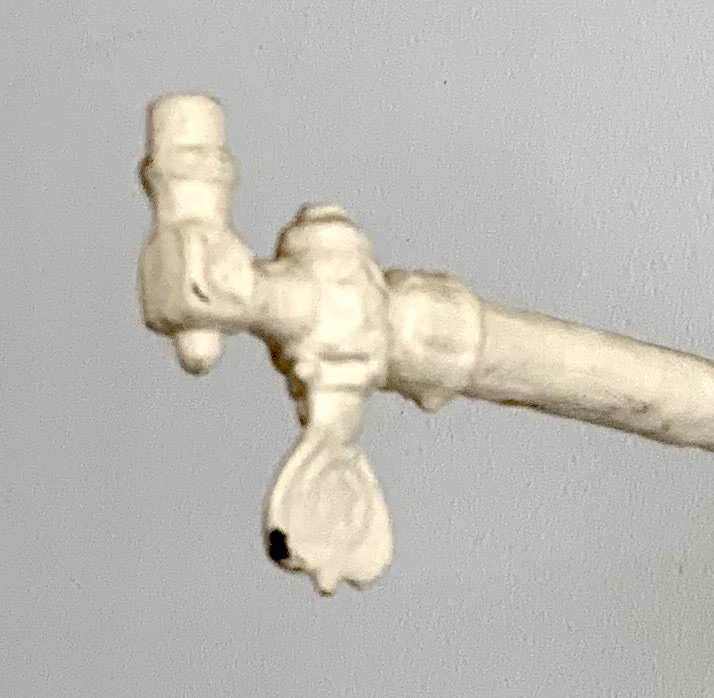

The fact that I have to explain what this is would have astonished New Yorkers of the late nineteenth century.
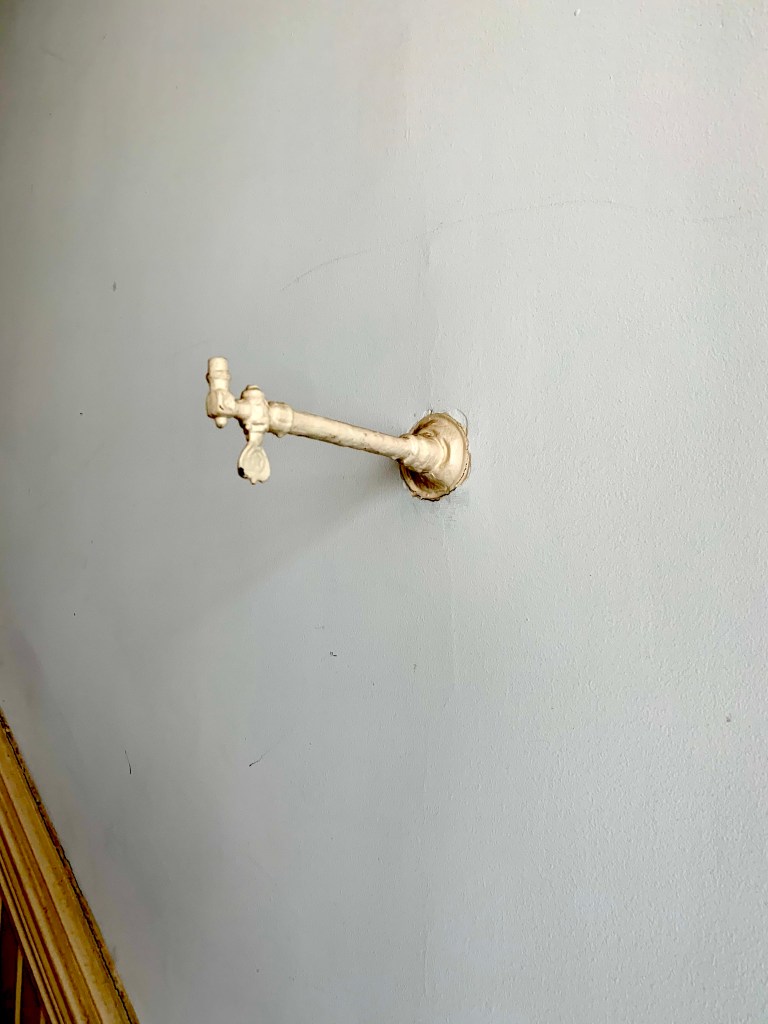
The picture is taken in a stairwell – you can see the sloped wainscoting along the stair on the left. And this thing is the base of a gas lamp. It’s missing the enclosure, which would likely have been a small glass cylinder (or something similar) on the far left end/ The thing that looks like a pipe is a pipe, which was filled with coal gas, and the bottom-most projection is the control portion of a valve (the valve proper is just above, inside the intersection of pipe). To light up the stairwell, you lifted off the enclosure, turned the valve on, lit the gas with a match, and put the enclosure back. To turn the light off, you simply turned the valve. (A long time ago, I read Time and Again, by Jack Finney, and as the protagonist is moving into a boarding house in New York in 1882, his landlord explains to him that you have to turn off the gas lamps, not simply blow out the flame as you would with a candle or oil lamp. Blowing out the flame while leaving the gas turned on would be, in the words of first responders everywhere, bad.)
Early electric light was, by our standards, dim, and the bulbs burned out annoyingly fast. But people switched from gas lighting quite quickly when given the chance. Electric light was steadier (less flicker), less likely to set fire to the building, and much less likely to accidentally poison everyone in the building. Some old gas fixtures, and the pipes leading to them, were converted to electric light with wires run inside the pipes, but most of the fixtures were simply removed after being abandoned.
You must be logged in to post a comment.