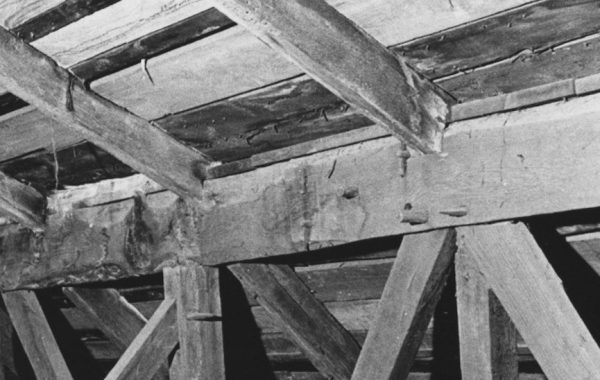
This article – which I think is absolutely worth reading – got me thinking about the meaning of adaptive reuse. The building in question, an 1880s grain warehouse, is a masterpiece of nineteenth century industrial construction and has been repeatedly photographed and written about in the last few years as it declines towards collapse or demolition. Its fate is still up in the air, so a few years from now it may be only a memory or it may have been renovated and put into use as something other than a warehouse.
In the greater scheme of things, the building isn’t that important. It’s a great example of an industrial style, but not much to look at; its social significance seems to be limited to the oddity of Mr. Bowne suing himself. (Okay, suing his own company. It’s still peculiar, in my opinion.) The neighborhood was a neglected industrial and low-income-housing backwater for 130 years and is now being gentrified. In other words, this is not the kind of building that people are necessarily going to fight very hard to save.
I could be wrong, but it’s unlikely that industry is coming back to Gowanus and Red Hook in any large-scale way. The land is now too valuable, the local workforce is too expensive, and the advantages that the area once had (access to both Atlantic shipping and the Erie Canal, for example) no longer mean much. So preserving the Bowne buildings means adaptive reuse: they are economically viable as buildings only if some other different use is put in them. It could be housing (although that’s unlikely), it could be a school, or a nightclub, or offices, or retail, or a new fad for indoor hay-bale mazes. Whatever it is, it won’t be warehousing and it certainly won’t be grain storage. Whatever the new use is, it will be a change from the past.
What then are we saving if we save this building? The shell of a not very pretty building? A name that no longer means much to many people? I’m going to argue for two ideas: diversity of building stock and diversity of streetscapes. Maybe I’m kidding myself, and maybe these are different names for the same thing, but I’ll argue that I’m not and they’re not.
The idea that having different types of buildings is inherently good is to some extent a recent one. Jane Jacobs argued for this in her writing, starting in the 1960s. On the other hand, late nineteenth century writers could describe rows of brownstones as creating monotony and mean it as a compliment. Certainly modern urban theory holds that having buildings of different types, different ages, and different potential is a benefit to a city.
Similarly, not all cities look the same and not all neighborhoods within a city look the same. That’s good. Part of how we experience of a given place is how it differs from other places we’ve been, and that includes its smell (and the Gowanus canal is famously fragrant), its sounds, and its appearance. How do I know I’m in Gowanus and not Brooklyn Heights? More than anything else, it looks different. I’m not in favor of trying to embed a city in amber, to preserve it against all change; I am in favor of retaining some degree of the past so that we can look around and know where we are.
We’ll see what happens to the Bowne buildings. But I find it hard to believe that they can’t be productively reused and I feel strongly that they should be.