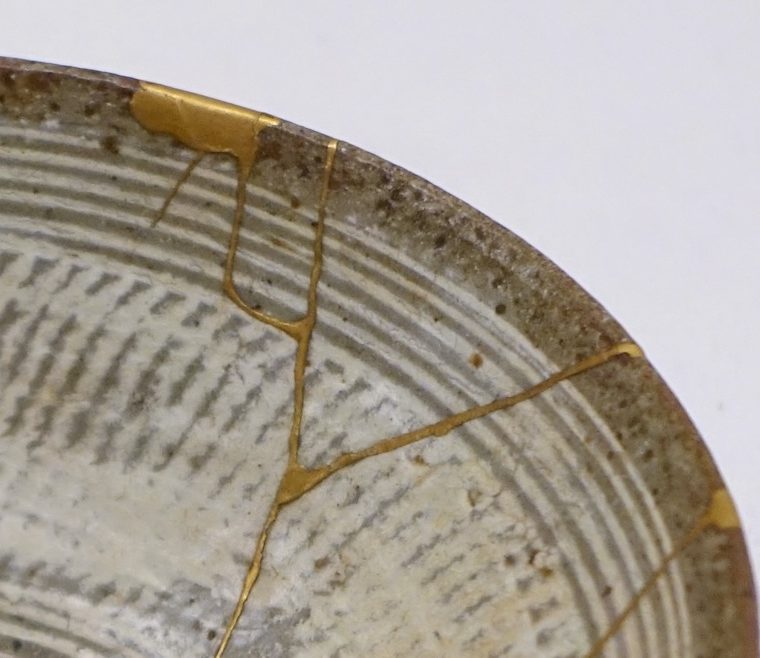

I read Rain Noe’s article “An Architectural-Scale Kintsugi Project” with some interest. Kintsugi is the art of repairing broken pottery with joints that deliberately contrast against the base material in appearance, leaving visible scars in the repair.

Noe is using the term for a proposal to repair a badly damaged 257-year-old house in Virginia. It seems from his description that, prior to restoration work beginning in 2020, all that was left were pieces of the four exterior walls – notably missing about half of the front facade – and less than half of the roof. The overall proposal is to rebuild the missing walls in glass. It’s not entirely clear from the renderings what is planned with the missing floor area, although it looks like it might be a combination of modern flooring and glass.
To get the obvious out of the way, this is not traditional restoration and makes no pretense of being so. On the other hand, the pre-2020 state of the building is best described as a ruin, which leaves several options, none of them ideal. The ruin can be stabilized, using only as much modern material as is needed to make it safe and prevent further deterioration. This is the “purest” preservation but in my experience doesn’t work well for the general public. Most people are not good at looking at a ruin and seeing – imagining – the completed building. One compromise that has been used, most notably at Philadelphia’s Independence National Historical Park, to is to erect an outline of a missing building in small steel members. This gives the public a sense of the scale and shape of a non-extant building. The missing portions of a ruin can be rebuilt, although reconstruction is the least “pure” version of preservation.
The proposal for this house is not unique, but it’s an interesting attempt to address the shortcomings of the various options. Per the Secretary’s Standards for Reconstruction, there is a clear distinction between old and rebuilt materials. Noe’s article makes it clear that traditional masonry restoration techniques have been used for at least some of the remaining material. If completed as planned, the result will not be a traditional restoration or reconstruction, but will still showcase the remains of the original building. There are not many buildings where I personally think this idea would be appropriate: if a building is in usable, or near-usable condition, it should simply be repaired and restored.

You must be logged in to post a comment.