

That’s my close-up of the top of one of the fence posts at Bowling Green. (Yes, it is on my walk to work. Thanks for asking.) As you can see, the top of the post is quite rough. In one of the more famous acts of vandalism in New York history, the Sons of Liberty took to the park on July 9, 1776 (having just heard about the signing of the Declaration of Independence five days earlier) and destroyed the statue of King George at the center and sawed the crown-bearing finials off the fence posts.
That’s a nice patriotic story and one that is endlessly repeated. I have no reason to doubt its truth, but some of the details are interesting from the physical perspective. For example, depending on which description you want to believe the fence is either cast iron or wrought iron. By looking at the object rather than reading a web site (shocking, I know) it appears to be both. The main posts sure look cast; and the skinny pickets and flat-bar horizontals sure look wrought. There’s no reason that it wouldn’t be built using both metals: in an era of expensive materials and space labor, people were very particular about using materials efficiently.
Better still, it’s a big fence. Here’s a circa 1902 photo (the construction in the foreground is the beginning of the Customs House) showing all of Bowling Green:
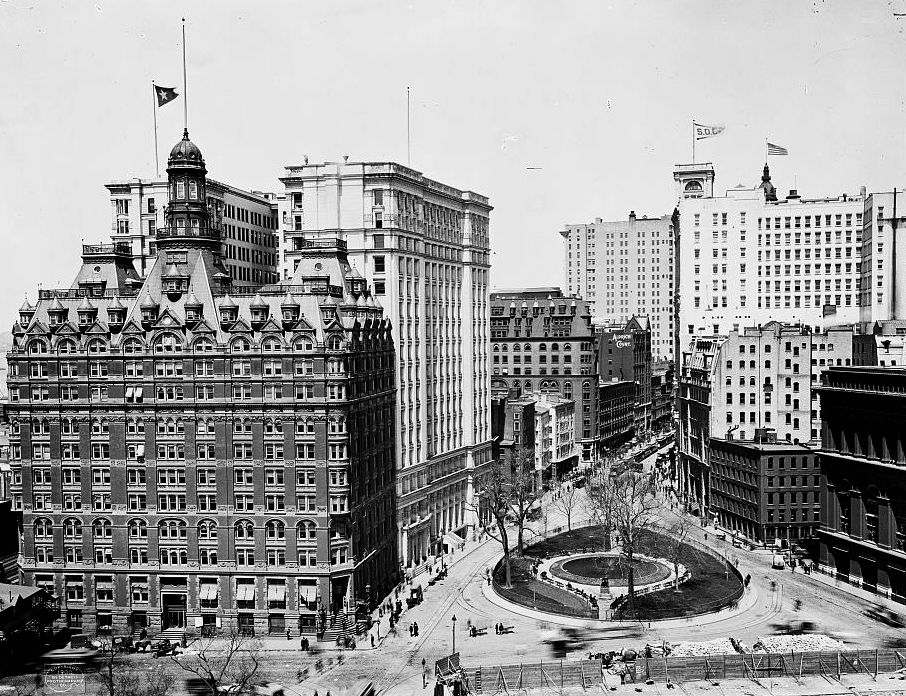
My informal count is that there are about 90 fence posts. Sawing through iron by hand is no joke, no matter how good your saw is, and in 1776 there was no high-strength tool steel and there were no diamond saw blades. My estimate for hacking though one of those finials is at least ten minutes each…which leads to 15 hours of sawing. I doubt the revolutionary vandalism fervor would last that long, but more importantly no one’s arm could take it. So there had to be multiple sawyers. If there were ten men with saws, that’s an hour and half each, which is still a lot of hard work. The estimated population of New York in 1776 was 25,000, but it was an era when craftsmen were common in cities. How many actual iron workers were there in New York? I’m sure there’s decent data on this somewhere, but I don’t have it, so I’m going to estimate.
in 1820, people in manufacturing (including hand artisans) and construction made up about 12 percent of the population. (U. S. Census Bureau “Historical Statistics of the United States: Colonial Times to 1957” table D 57-71.) A lot of those people would not have had a saw readily available to cut iron. The carpenters, masons, and laborers involved in construction, or joiners working in furniture-making, for example, would have had little or no cause to cut iron. And using a wood saw on iron might work, but it would also blow the 10 minutes per fence post estimate apart. Manufacturing was a bigger deal in the U.S. in 1820 than it was in the colonies in 1776, if nothing else because there were no colonial laws limiting it. (The nascent American branch of the industrial revolution helped, too.) At 12 percent, there would have been some 3000 people in manufacturing and construction in New York in 1776. If those were evenly divided (a number I’m pulling out of the air to be able to move ahead) between manufacturing (where some iron work was necessary) and construction (where it was much rarer), then we’ve got 1500 people in manufacturing. Using similar logic to divide off those with a reason to work iron, and we’re down to maybe 750. If we assume a lower percentage of people in the trades in 1776 compared to 1820, because of the more primitive manufacturing context, we’re down to maybe 500. Then we have to take into account people who supported the rebellion (who might have gone to Bowling Green that night) versus people who were loyal to the crown. If the percentage of loyalists was the same in New York as for the colonies as a whole, we’re down to something like 400 people.
These numbers are almost certainly wrong, but they suggest that there were easily enough men available with the tools and experience to cut iron quickly. My childhood mental image of the NY Sons of Liberty was of a small band, maybe a dozen men, sneaking into a park to attack the symbols of colonial power. In reality, given the amount of work in cutting up the statue of the king and in cutting off the tops of all the fence posts, I suspect it was a lot of people. There’s nothing quiet about sawing iron, there would have been multiple saws working at the same time, and there were plenty of residences in the area back then, so this was no sneak mission. It was crowded and loud. Or, I’ve made some unjustified assumption and my whole analysis is off.
The fence is a landmark, saw marks and all.


You must be logged in to post a comment.