
There are a lot of clues to construction dates of buildings. Technology never changes all at once, so buildings tend to be a mix of new and old technology; the mix varies with size, location, and the intentions of the owner and AEC team, but it’s almost never all one thing. If you set out to build a log cabin today, your tools will be modern tools* and therefore will leave different marks on the wood than tools of the eighteenth or nineteenth centuries would.
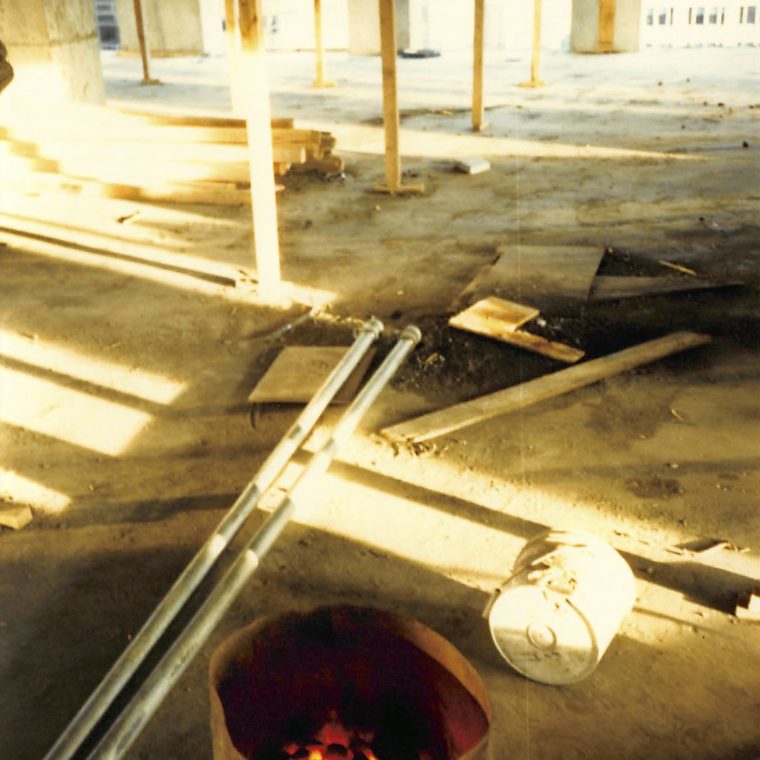
The picture above shows a concrete-frame high-rise under construction. There are some clues about age, like the plastic bucket in the foreground. The most interesting thing present is the salamander.** The picture was taken in February picture and that is a big tin can full of charcoal being used to heat both the workers (mostly) and the concrete above (a bit). The absence of forms on the concrete and the presence of reshores (the 2x4s propping up the slab above while the concrete cures) suggest that the picture was taken something like a week or two after the concrete was placed; at floors where the concrete was still wet there would be a lot more salamanders to keep the concrete warm for winter curing. Current practice tends more towards propane heaters with fans attached. Note also the minimal edge protection, which makes it clear this is not a current-day picture.
You can see the marks of the edges of large forms on the columns, but that doesn’t help much with dating, since pre-fab column forms have been around since the 1910s at least, and reinforced-concrete construction in the US is almost entirely a post-1900 phenomenon. Here’s another view that gives a little more information:

You can clearly see the edges of the 4-foot by 8-foot sheets of plywood that were used to form the slab above. There’s more edge protection here, but again it doesn’t meet current standards. Older concrete would have been board-formed, and a newer site would have edge protection that could actually stop you from falling, as opposed to giving you a warning that you could fall.
This was February 1988, or 31 years ago. Counting backwards, that’s about a quarter of the way from the present day to the first concrete high-rise in the world, the Ingalls Building in Cincinnati. So, as recent as that day on site seems to me, it’s part of the historical continuum of concrete high-rise construction, and can be examined in the same way that we examine older buildings. If I were to go over the design of that building, there would be all sorts of differences from current practice as a result of code changes, most obviously the lack of seismic design.
Construction technology, like all other technologies, carries its history within its artifacts. The difference from most other technologies is that the artifacts are generally longer-lived than people, so we get to experience many eras at once. We get to see the continuum just by looking at our surroundings.
* Assuming you’re not deliberately using old-fashioned tools.
** Construction is full of very old language. Calling something a salamander because it’s full of fire is literally medieval.


You must be logged in to post a comment.