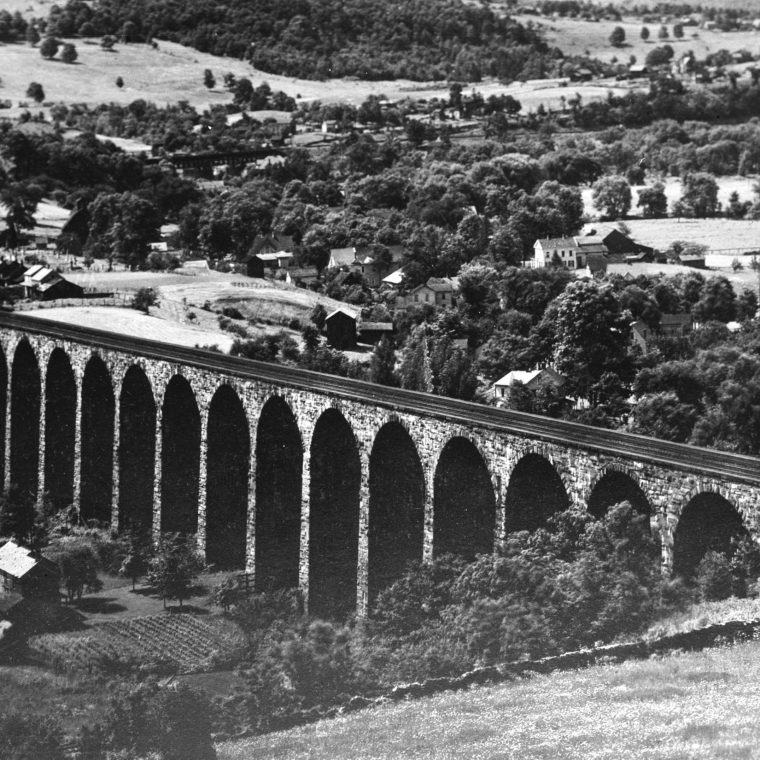

I’ve talked in the past about metal railroad viaducts and wood railroad viaducts, so I guess I’ll round out the collection with masonry today and concrete tomorrow. That’s the Starrucca Viaduct, in northeastern Pennsylvania near the New York border, completed in 1848 for the main line of Erie Railroad. It’s entirely made of stone and has 18 semicircular stone arches, each spanning more than 50 feet, up to 110 feet above the Starrucca creek valley. The 1920 photo above gives a sense of the entire thing, but the HAER survey has some spectacular close-up photos…

…as well as some interior details hinting at the methods of construction.

This type of masonry viaduct is reasonably common in Europe. I’ve spent a fair amount of time reading Bill Harvey‘s “Bridge of the Month” and he’s described any number of roughly similar viaducts in the UK. These are so rare in the US that Starrucca stands out as one that was actually completed and is actually still in use. The obvious question is: why the difference?
Railroads in Europe were generally built between established cities on established routes, paralleling existing roads and canals. That condition existed for early railroads in the US – for example, the Hudson River Railroad paralleling the river from New York to Albany, or the Baltimore & Ohio Railroad paralleling the Chesapeake & Ohio Canal – but it mostly was not true here. For example, travel across the width of Pennsylvania, between Philadelphia and Pittsburgh, was difficult and time-consuming before the construction of the Pennsylvania Railroad. This condition was especially true west of the Appalachian Mountains, where railroad construction influenced the founding and growth of cities as much as the reverse.
It was clear early on that the railroads were iterating their routes: guessing as to the best path to travel and changing it when circumstances required. And US railroads were generally poorly funded on a per-mile basis compared to their European counterparts, meaning that construction had to be inexpensive. Starrucca was famously a bad example to follow, being incredibly expensive for its era. Finally, the weight of trains, and particularly engines, increased every decade, quickly making old designs obsolete. From 1850 to 1900, the general pattern for US railroads that needed viaducts was wood or wrought iron construction followed by steel.
Given the beauty of this structure, thought, it’s hard not to wonder what might have been.


You must be logged in to post a comment.