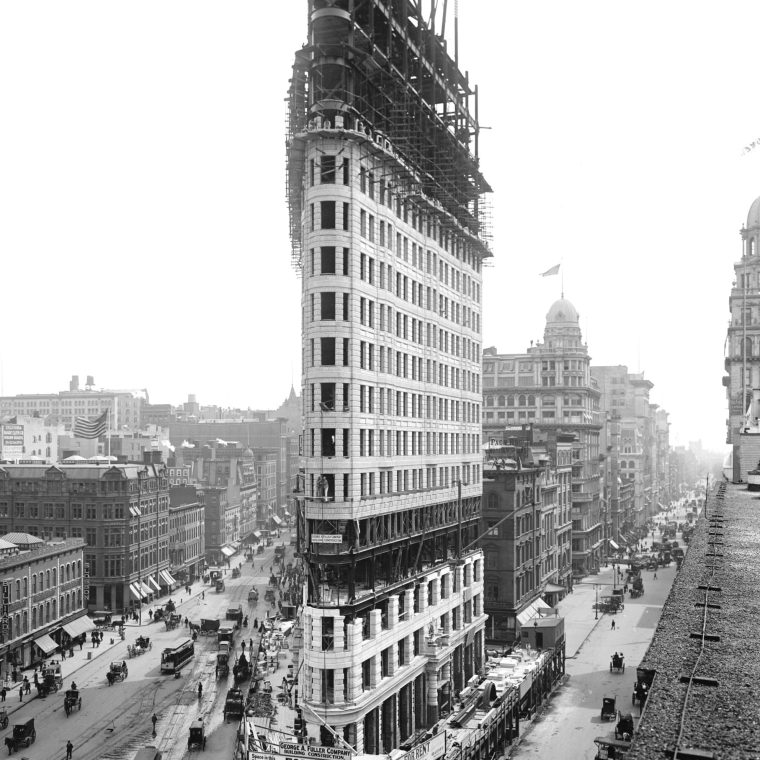

By generally switching (for buildings bigger than a house or small free-standing store) from bearing-wall to skeleton-frame construction, engineers and builders reaped a number of benefits. Some are obvious (steel and concrete are stronger than masonry, so it became easier to build high) and some are not. Most people who are not in the business won’t think of decoupling exterior wall construction from overall construction as important, but it greatly speeds up the work. In modern terms, the exterior walls are removed from the critical path for structural work, allowing the building to be topped out faster. Note that “decoupled” doesn’t mean “simultaneous” (the situation with bearing-wall construction) nor does it mean “sequentially”: the photo above shows how the curtain wall of the Flatiron Building was being erected at its own pace as the steel frame neared completion.
We don’t generally talk about the downsides of the switch to skeleton framing, because they are generally less importnat than the benefits, I want to talk about one downside that’s a bit esoteric: the growing reliance on reductive thinking. The various elements of old bearing-wall buildings, including the wood-joist floors commonly used in New York, were designed by rules of thumb. Those empirical rules were sometimes just general knowledge and sometimes codified, but they were typically based on experience rather than analysis. A steel skeleton, like that seen above, was designed both overall (lateral-load analysis for wind pressure on the building as a whole) and in pieces (each beam, column, and connection had to be designed). This was a huge increase in work in effectively a new field, and engineers looked for any way to simplify that they could. There were load tables for beams and columns, for example, that simplified design.
The real simplifications came from how the pieces were modeled. An actual column with riveted splices and riveted beam connections is a complex object. The model used in analysis is literally a 1D line, with various end conditions and loads applied to it. It was (and still is for most buildings) common to treat ordinary splices as pinned connections, incapable of transferring bending moments, even though that’s simply not true. It’s a “conservative assumption,” meaning that it’s believed to represent a worse case than reality. This kind of assumption is taken to be harmless, and there are many in engineering modeling.
Portions of the bundling deemed to be “non-structural” were simply excluded from the models. In many buildings – not so much the Flatiron because of its slenderness, but most steel frame buildings of its era – the perimeter columns were embedded in masonry walls that were nearly as strong as the steel columns and were far stiffer than the columns. Since load follows stiffness, the exterior walls inadvertently acted as bearing walls. Excluding the masonry walls from the structural model is a conservative assumption (if the walls fail, the frame is still strong enough to carry load) so it’s not wrong in terms of being unsafe but it leads to some funny results. Old steel-frame buildings are far stiffer under wind load than modern analysis says they should be, specifically because the masonry is carrying load. Masonry damage patterns, serious or not, can be impossible to explain if you assume, as the model does, that all of the load is in the steel. Steel damage can be hidden for years because the masonry carries the load.
Structural drawings for new buildings show masonry walls, when they show them at all, as objects adjacent to, and loading on the steel frame. They are excluded from the “structure” club and treated as unimportant. It may be a conservative assumption and therefore safe, but it’s an incomplete picture that has come to dominate our thinking. And if you’re saying “we no longer use heavy masonry curtain walls without expansion joints so this doesn’t matter with contemporary buildings,” well you’re right and you’re wrong. Try calculating the strength and stiffness of steel-stud, gypsum-board partitions in a mid-rise apartment house and compare them to the structural frame.
Tomorrow: what do you mean the actual world is three-dimensional?