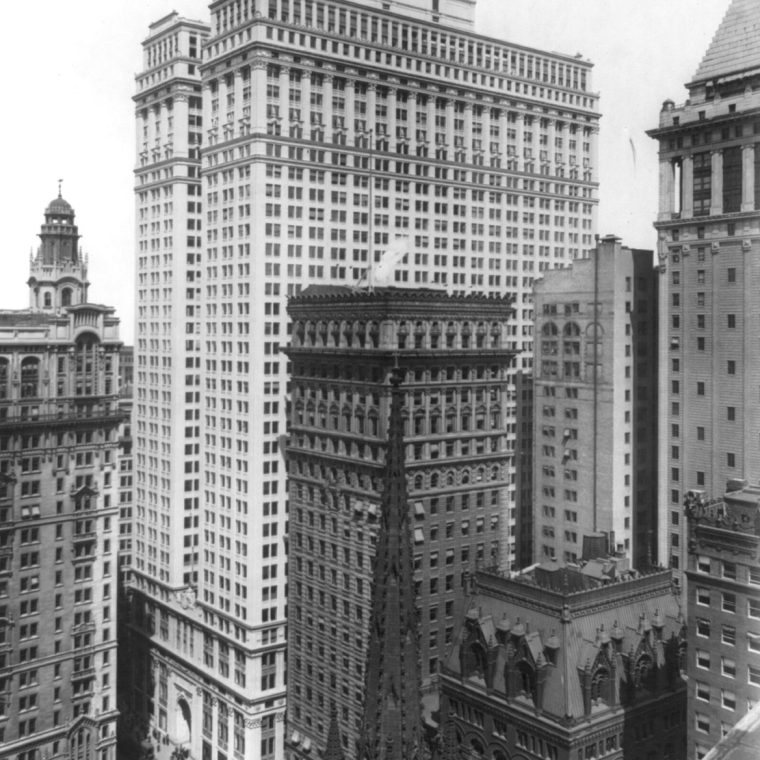

To wrap up my dive into this document, it’s important to point out the specs are over 300 pages long. It’s a lot and comparable to a modern spec book. The emphasis is different: the Equitable specs spend more time defining materials because the ASTM and other similar sources had not yet provided definitions of every conceivable material that could show up in a building.
Office buildings of this type, meant to house vast numbers of clerks, were about twenty years old at the time. There were certainly commercial offices earlier than that, but they were generally smaller, simpler buildings. Of course, the further back in time you go, the simpler the buildings get: the 1850s law-office described in “Bartleby the Scrivener” didn’t have modern plumbing, or HVAC other than fireplaces and operable windows. New York commercial buildings of the mid-1800s had wood and brick super-structure, masonry foundations, maybe some stone veneer; largely wood interiors, with plaster finishes and maybe a little tile flooring. The doors and windows were wood. Plumbing was limited and simple. In short, constructing such a building meant hiring a mason and a carpenter, and then dealing with a few other details.
Obviously, a steel-frame building like Equitable will have more complicated structure. But that in itself is a small piece of the specs. The structural sections are maybe 30 or 40 pages out of the total. Looking at some specifics will give a sense. There would be little metal in that 1850 building: nails and bolts, bridle irons in the wood floor framing, some pipe, some small pieces of the fireplace assemblies (fireplace lintels, dampers). All would be wrought or cast iron and all would be standard stock elements. Metal at Equitable includes the structural steel of the frame, the separately-defined structural bolts and rivets, ornamental wrought and cast iron and cast bronze, specialty items such as revolving-door assemblies and mail chutes, sheet-metal flashing, multiple forms of piping, metal flues, window frames, and hollow-metal door frames. The brick (and maybe a little stone ornament) of 1850 gave way to brick, structural terra cotta, ornamental terra cotta, terra cotta partitions, terra cotta fireproofing, and six grades of concrete for various uses. Similar expansions of scope exist for every material and system used in construction, as well as the introduction of completely new systems such as electric wiring and lighting.
In short, the modern building wasn’t just much bigger than its predecessors, it was far more complicated. Rather than two trades constructing nearly all of the building, dozens were needed, as well as far more off-site fabrication. Many of the new materials and elements were relatively recent additions to buildings and were based on relatively recent technology, which meant that there were no generally-accepted standards that could be relied upon the way that people had earlier relied on general knowledge of the acceptable quality of brickwork and rough carpentry. Even if there had been such informal standards, the complexity of the building would argue against counting on them rather than written descriptions of the work expectations. Hence, a 300-page spec book.

