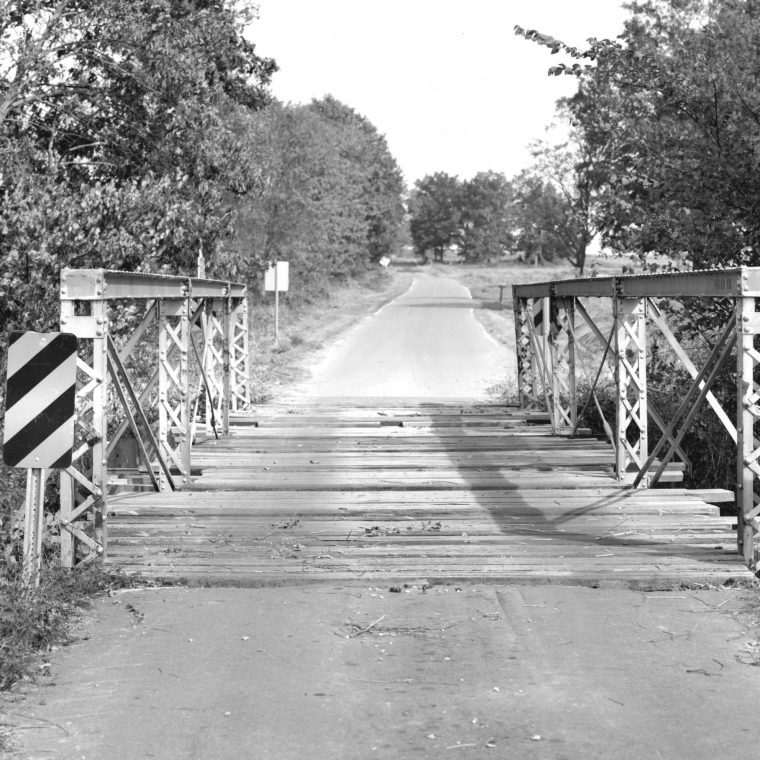

A HAER report taught me a new term today: bedstead truss. My first thought is that it was an oddball form named after someone named Bedstead (see below), but it turns out that’s not the case. The example I came across was this little bridge carrying Kentucky state route 124 over Sugar Creek.
Some physical basics: it was constructed in 1894 and replaced in 1985, was 44 feet long and not quite 10 feet wide. The 1983 HAER report describes it as “in poor physical condition” but retaining its structural integrity. My guess is that even in a rural area it made more economic sense in the 1980s to replace it rather than repair it. In 1983 it was the oldest bridge of its type in the state and the only one built by Groton Bridge Company of Groton, New York.

If asked to describe this bridge, I’d have immediately said it’s a Pratt pony truss with eyebar diagonals. The HAER report gives two names in addition to that, calling it a “bedpost truss” and a “truss-leg bedstead”. The definition of a bedstead truss that I first found simply said it’s a truss with vertical end posts in compression, which was underwhelming. The end posts of a Pratt truss are always in compression, and the difference between vertical or inclined end posts isn’t much for such a short span.

As I worked my way through the photos, they got around to the underside and suddenly the name made more sense:

There’s a lot going on here, but everything has a purpose. The deck girder running lateral across the bridge supports the steel stringers running parallel to the bridge, which in turn support the wood plank deck. The deck girder is supported from the bottom-chord pin connection of the truss by big U bolts, and it cantilevers past the supports to carry braces for the top chord. The bottom chord at the center of the three panels is a pair of eyebars. And then things deviate from the ordinary truss bridge. I’d expect the bottom of the end posts to be at the bottom chord, with those connections sitting on abutments. Instead, there are no abutments of that type, and the end posts continue down to the ground where they presumably sit on some kind of footing. The bottom chord at the end panel, instead of running straight, slopes down a bit to intersect the lower extension of the end posts a couple of feet below the deck. And suddenly the name is clear: the bridge, from the side, looks like a bed frame, with the lower extension of the end posts as the legs and the truss as the bed frame. Clever idea, but one that will only work for quite small bridges: the lower extension of the end post will be subjected to very large moments if you try this on a large scale.
This is reasonably far off the beaten track, but why did I think of something much further off? I’m used to strange coincidences about names. The first of two local examples, the Holland Tunnel under the Hudson River has nothing to do with New York’s past as a Dutch colony, but rather is named after its chief engineer, Clifford Holland. Even better, the large cantilever truss bridge over Arthur Kill between Staten island and New Jersey, at the extreme southwest corner of New York City, is called the Outerbridge Crossing because it was named after the first chair of the Port Authority, Eugenius Outerbridge, and “crossing” was used to avoid having it called the Outerbridge Bridge.

Permalink