
February 1, 1956, Max Hubacher shows us the demolition of the el, titled “42nd Street and 3rd Avenue, Manhattan”:

The elevated steel structure ends abruptly about a block or two up the avenue, with the sun fittingly glaring on the street beyond. There are piles of demolition debris – wood and steel – on the left behind the line of people crossing the street and on the right. The wood would be coming from the station roof and walls and the rail ties; the steel from the main elevated structure and from the station skeleton. Note the saw horses used to direct pedestrian traffic away from, presumably, the areas of work.
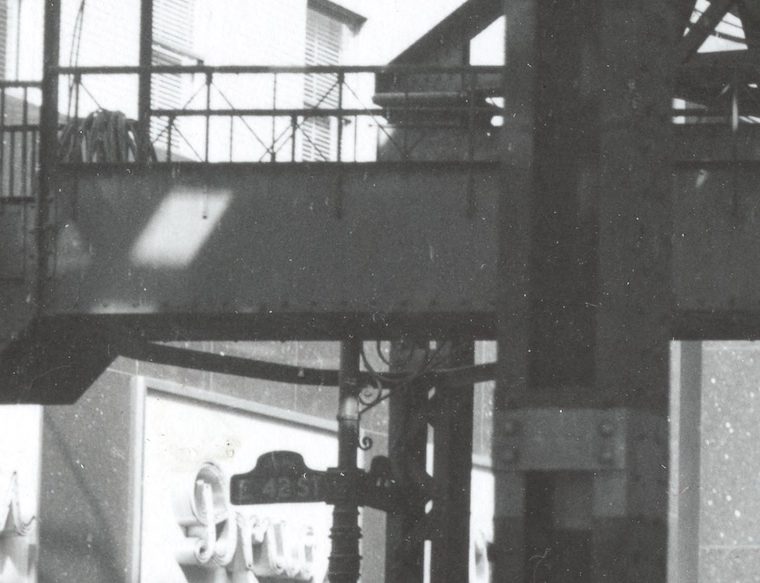
On the left is a street sign that shows exactly what we’d expect: the street running in the direction we’re looking is Third Avenue and the street crossing in the foreground is 42nd Street. That doesn’t tell us if we’re looking north or south. On the right, next to the truck full of debris, is a sign proclaiming the WHITE ROSE BAR; a little research shows that there was a bar with that relatively common name at 43rd Street and Third Avenue. So we’re looking north. We can only see one large building, on the left, and that is reasonable corroboration. There was nothing large on the blockfront southeast of the intersection in 1955:

But there was on the block northwest of the intersection:

“Chrysler Building East” is 666 Third Avenue, completed in 1952, and much shorter than the original Chrysler Building.
Moving on…we can clearly see that there were three tracks. This was an express system first developed (in New York, I don’t know about its use before or after elsewhere) with the els, and then was used in some subway lines. Express trains run inbound towards the center of the city (downtown in the case of the Manhattan els) during the morning rush and outbound during the evening rush.
On the far left, we can see a diagonal beam running southwest from the el structure towards 42nd Street west of Third Avenue. That’s probably a remnant of the Grand Central stub, demolished in 1923 because the construction of the IRT subway in 1904 had made el service to the railroad station unnecessary.
Finally, most of the structure consists of built-up columns and trusses, but there are big plate girders spanning side to side at each column line. There’s also, in the foreground, a pair of plate girders running side-to-side hung from the structure above – and those plate girders are the lowest piece of horizontally-spanning steel we see. If you look closely, you can see a decorative handrail above those girders. This is a cross-over, to allow passengers to use the stairs from the street to the station on one side of Third Avenue to get to the platform on the other side.
TL;DR: Reality is complicated and messy.
You must be logged in to post a comment.