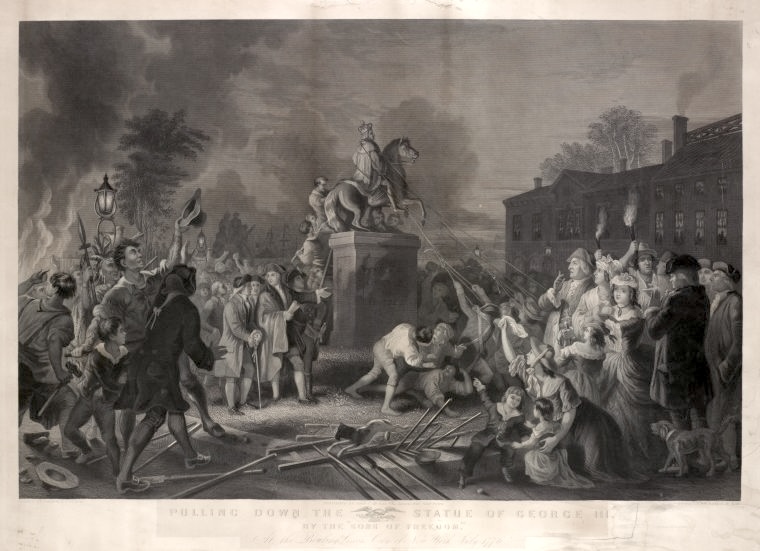

On July 9, 1776, a bunch of New Yorkers – who maybe or maybe were not part of an organized group called the Sons of Freedom – celebrated the publication of the Declaration of Independence by pulling down a six-year-old equestrian statue of King George III at Bowling Green and destroyed it. It was a nice defiant act as a way to kick off a war, and at least some of the lead statue was made into musket balls. At that time, Bowling Green was New York’s “central park.” It was the oldest park in the city, and the only real competition was the Commons, which would later become City Hall Park, which was on the northern outskirts of the city.
The picture above, engraved in 1859, is a reasonably accurate view of Bowling Green and the nearby buildings in 1776. The descriptions I’ve read do not include destroying the iron fence (which is still there. I’m not sure if the artist, John McRae was intentionally portraying the crowd as giddy and possibly drunk, if he accidentally gave that impression while trying to portray people as celebrating, or if I’m simply over-analyzing. The picture below, issued in 1776 is…something else.

That may be the least New-York-looking view of New York I’ve ever seen, in two languages. Putting aside the middle-European architecture, Bowling Green doesn’t exist, the couple in the second-floor window on the left seem to have got lost on their way to Versailles, and the vandals/Sons-Of-Liberty are wearing shorts and no shoes. I have a theory about that last weirdness: some of the men who participated in the Boston Tea Party three years earlier – a protest that actually was organized by the Sons of Liberty – wore (probably not very convincing) disguises to look like Native Americans. My theory is that the artist who created this second view either conflated the two events or thought that the Sons of Liberty walked around all the time barefoot and wearing face paint.

You must be logged in to post a comment.