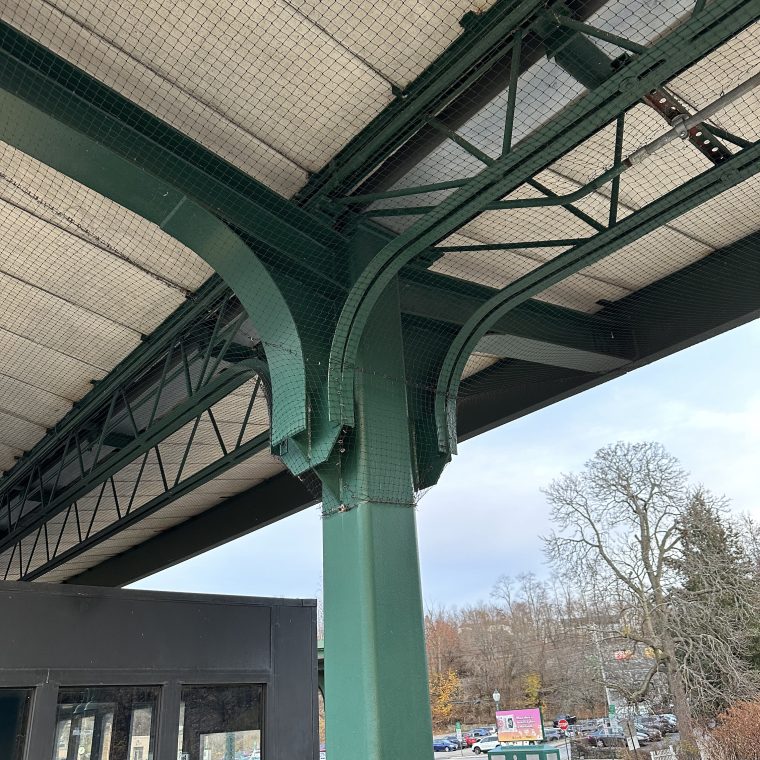

I’ve shown a few old train stations with curved steel in their canopies. The picture above, taken yesterday at the Peekskill station on the MTA Hudson Line – AKA, a local station on the former main line of the New York Central – shows a modern version. I’m not sure when this canopy was built, but the station underwent a major renovation in 2013.
I really appreciate them trying to match the appearance of the old canopies. This could easily have been incredibly boring. That said, it doesn’t quite work, and I spent some time trying to figure out why I feel that way. (On a side note, the small grid you see everywhere is pigeon netting, to keep birds from landing and nesting on the steel.)
First, the tube column is fine, both structurally and aesthetically, but it is visually heavier than the built-up columns that the old canopies had. Next, the welded bottom curve on the cross-girder (which cantilevers both sides of the column, the short way, to support the edge beams that run along the length of the canopy) is nicely done, and a good update on the riveted bent plates and angles used on the past. But the center longitudinal girder is a pair of open-web joists, with the bottom chord curved down. The curved portion of the joists is meaningless: there’s no load in the lower chord from the last joint (where three web members come together at the bottom) to the end, so the curve is purely for show. That may be true on the cross-girder as well, but at least there it’s a believable fake.
Most disturbing, the curves all end in thin air. Visually, there should be some kind of bracket below the curve to connect it back to the column; structurally, any load in the curved lower flanges/chords can only be resolved by connecting them to the column. I see two obvious possibilities here, although there may be others. The first is that, in a fit of post-modernism, the decision was made by the designers to deliberately end the curves in thin air to show off their fakeness. The second is that the curves were seen as part of the architectural design rather than structural design, and so no thought was given to their meaning.